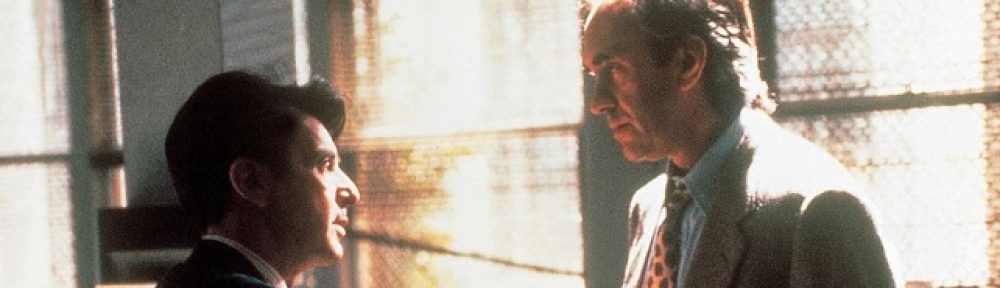
Bad Santa (2003; dir. Terry Zwigoff)

“Is Granny spry?”

Bad Santa avoids a tragic end by lowering itself into Life’s murkiest sadness.  It’s a very funny movie, but if one focuses too much on Willie Stokes’ (Billy Bob Thornton) outward behavior you might just miss the film’s poignancy.  This Santa is a decent man trapped in the life of a smarmy, self-loathing, depressive, alcoholic criminal.  After sinking so low, even the slightest upward movement feels like a triumph.

There is no formal plot to write of, but there is a story.  Willie Stokes and his partner-in-crime, Marcus (Tony Cox), annually find holiday work performing as Santa Claus and a Christmas elf, respectively.  They like to work in a mall…any mall, anywhere.  Their true purpose is to then rob that mall after closing on Christmas Eve when undeposited cash and high-end merchandise are readily available.  They change cities every year and have successfully managed this heist many times without being caught.  Their plan works.

There’s also Marcus’ wife, Lois (Lauren Tom).  She’s their getaway driver.  More importantly she scopes out the different stores looking for both security issues and for merchandise.  She keeps a list of all the things she wants, and Marcus steals each item.  He hauls it all back to her, along with the vast amount of cash money.

So, they are reasonably smart criminals.  Really, they are.  Willie, however, is in an emotionally bad way and his everyday behavior is simply out of control.  He drinks constantly, repeatedly fornicates at the mall with mall patrons, verbally scolds children and all while wearing his Santa costume.  He is not Santa Claus, and in fact clearly tells us so several times.

Willie meets a bartender (Lauren Graham) and spends a lot of time with her.  She’s very nice, very honest, and seems to genuinely like him, despite his…well, just despite him.  He also meets a Kid (Brett Kelly) and, after a near run-in with the police, worms his way into the kid’s home as a place to stay for a while.  People still like Willie even though he’s a drunk, he’s dishonest, he doesn’t like children very much, and he’s a thief.

But he’s not a bully.  No way.  Willie Stokes, if nothing else, wants you to know he is absolutely not a bully.

In fact Bad Santa is more concerned about how to handle bullies than it is a about tact, Thank God.  Terry Zwigoff’s movie knows that one cannot discuss handling bullies and still be tactful.  It destroys any audience expectation of a standard comedy when, in the very first act, Willie wets himself while in the Santa costume, sitting on Santa’s throne.  I’m always relieved he at least waited to urinate until the children were gone.

Much of the story involves Willie instructing the Kid on how to be assertive, how to stand-up for himself to bullies.  He talks to him, shares stories, yells at him and even takes the Kid to a boxing club for sparring lessons.  He knows what to do, and the Kid does learn, but Willie just never takes his own instruction to heart.  He is a defeated man, having been bullied his entire Life by his father, schoolmates, the Army, his own self-loathing and now by his partner, Marcus.

The film wisely never tells us exactly why Willie finally stands up for himself.  His self-esteem does seem moderately improved.  Clearly he’s grown fond of the Kid and after he beats up a few of the Kid’s tormentors even wonders if things feel better.  “I think I’ve turned a corner,” he admits, “I beat up some kids today, but it was for a purpose.”

Willie’s need to assert himself is clear, but the opportunity to finally express that need arrives unexpectedly.  Marcus, after years of Willie’s alcoholic misdeeds, finally decides to kill his partner.  It’s while brandishing his gun and threatening Willie that the film delivers an emotional wallop.

Faced with Marcus and death, Willie does not plead for his Life.  He even chuckles at the idea, admitting that he understands why his Life is worth ending.  In the dialogue, there is a subtle but profound shift in Willie’s tone, from scared and sad, to angry and resolved:

Marcus:  (pointing a gun at Willie) Willie, this has been a long time coming.  Every year you’re worse.  Every year less reliable.  More booze, more bullshit, more butt-fucking. 

Willie:  Sure, the three “B’s.”

Marcus:  You got to be able to rely, Willie.

Willie:  (after a moment; quietly, almost a whisper) …You people are Monsters.

Marcus:  There’s no joy in this for me.

Willie:  (indicating the gun; chuckling) I’m not talking about taking me out, that part I “get.”  But look at all that shit.  Do you really need that shit?  For Christ’s sake, it’s Christmas.

For all his faults, Willie recognizes the material excess Marcus provides to Lois, and he’s offended.  With death looming, he takes a stand against Marcus, his chief bully, by condemning Marcus not as murderer but as materialistic and shallow.  We don’t notice, but the film prepares us for this moment.

That’s masterful storytelling.

There’s so much more to write about this film and but for column space I would continue.  This film’s simple structure belies its literate achievement.  Through comedy it illustrates a very sad man, trapped in the role of a victim, who finds enough strength to finally stand up and say Maybe I’m about to die, but you’re an asshole and I’m still better than you are.

Not the usual list…

Here are ten mostly unheralded moments from film history, listed in chronological order.  Of particular importance are the individual moments, and not necessarily the films as a whole.  Oh, and these are Holiday Themed movies.

  1. ‘Twas the Night Before Christmas (1914; dir. Ashley Miller):  Simply the fact of this film’s existence.  As soon as movies could tell stories, filmmakers wanted to make this story. It’s magical.
  2. Going My Way (1944; dir. Leo McCarey):  The image of Father Fizgibbon (Barry Fitgzerald) standing stoically silent after Father O’Malley (Bing Crosby) gives him a Christmas present.
  3. It’s a Wonderful Life (1946; dir. Frank Capra):  Sure, in the end George has enough money and lots of friends, but Mr. Potter is still alive, still wealthy, and still a prick.  This is Bob Cratchit’s fairy tale, not Ebenezer Scrooge’s.
  4. Scrooge (1951; dir. Brian Desmond Hurst):  Scrooge’s (Alistair Sim) exasperated sigh of surrender when he meets the Ghost of Christmas Present, then turns away wanting to just go back to bed.
  5. A Christmas Story (1983; dir. Bob Clark):  It’s a beautifully photographed movie.  Reginald H. Morris’ cinematography gives us one of the greatest single shots in film history:  Mother and The Old Man, sitting together on an armchair, a Christmas tree alight, watching snow gently fall outside their front room window (a window, by this time, vacated by The Major Award).
  6. National Lampoon’s Christmas Vacation (1989; dir. Jeremiah S. Chechik):  Mirroring my own astonishment at how well this film was made, Clark (Chevy Chase) nicely sums up the day-to-day experience of his Life, “If I had woken up with my head sewn to the carpet, I wouldn’t be more surprised than I am right now.”
  7. The Nightmare Before Christmas (1993; dir. Henry Selick):  Frantic that he’s ruined Christmas after all, Jack asks Santa if there’s still time to set things right.  Santa simply replies, “Of course there is! I’m Santa Claus.” Kringle-Ex-Machina.
  8. Love Actually (2003; dir. Richard Curtis): Celebrating Love, happy or sad, in all of its myriad forms has rarely been so well done.
  9. Bad Santa (2003; dir. Terry Zwigoff): “You people are monsters,” he finally tells his partners-in-crime. Even the alcoholic criminal Willie Stokes has lines across which he will not step.
  10. The Polar Express (2004; dir. Robert Zemeckis): Laborious, costly and counter-intuitive, here anyway is the first feature-length motion picture crafted primarily from motion-capture technology.  And, boy howdy, it’s beautiful.

Planes, Trains and Automobiles (1987; dir. John Hughes)

“How do they know which way we’re going?”

Comedies challenge me.  It is very difficult to amuse when people do not all laugh at the same jokes.  I tend to view a comedic cast not as actors but rather as performance comedians doing their shtick.  It’s an entirely unfair perception, and consequently my expectations for comedy can be very unreasonable.

To help me focus on the actor, not the comedian, I have to visualize a comedic film as a present, and my job is to open it without tearing the wrapping paper.  Yes, it can feel like a chore, but a periodically rewarding one.  Even so, like those “it’s the thought that counts” moments, contemporary comedies test my skills.

For a long time, Planes, Trains and Automobiles confounded me.  It definitely felt like a comedy, yet it never felt like an effort.  I didn’t need to think my way into this present; it just unfolded and opened itself in front of me.

Do not misunderstand.  There are moments throughout the movie that still strike me as more over-the-top than necessary.  Early in the film, while standing on Park Avenue, Neal Page (Steve Martin) attempts to buy a cab from another bystander, and when said cab gets away from him, he goes after it, running in the jerky, stiff movements of Steve Martin’s comedy (yes, I used the word “jerk” on purpose).  It’s noticeable, and pulls me out of the suspense.

And since I mentioned noticeably awkward moments, there’s that ending…sigh…which I will address later.

Yet I forgive the film its awkward moments because for each of the very few that are there, probably twenty more organically funny moments appear.  It really is a beautiful movie filled with great images, and terrific dialogue.

Notice that first conversation between Neal and Del Griffith (John Candy).  I always refer to it as the “I Knew I Knew You” exchange and it’s the most crucial moment of dialogue in the film.  Del recognizes Neal, asks Neal his name, and realizes he’s the one who stole Neal’s Park Avenue cab.

Del of course feels terrible about the situation.  He offers to buy Neal some dinner as penance, a hot dog and a beer, and when Neal refuses, Del begins listing item after item of other things (“…Lifesavers, Slurpee …”).  It’s the early example of how Hughes writes in Uncle Buck (1989) and Home Alone (1990).

It’s also the moment when Del imprints himself upon Neal.  They establish not only their give-and-take relationship, but also their personality types.  It’s like a primer for the Myers-Briggs Type Indicator assessment.  Neal quietly refuses Del’s offer and remains self-reliant, but continues to inwardly scowl, preferring his judgmental superiority complex to actual human interaction.  Del openly displays his emotions, figures out the problem, and then tries to solve it by appealing to Neal’s emotional needs.  Hughes outlines their entire relationship, and the film’s conflict, in this simple and witty exchange.

The best dialogue comes while in St. Louis when Neal has to trudge back through snow, across bridges and runways, in order to confront his Rental Car Agent (the incomparable Edie McClurg).  It’s all build-up and pay-off, leading to the film’s greatest moment, “The F-Bomb Soliloquy.”  The monologue is Shakespearean, displaying Neal’s most pompous and arrogant self as he basically justifies why he’s entitled to things everyone else must be denied.  I imagine David Mamet smiles at this moment.

And of course McClurg’s final response to his tantrum, her timing, and her facial expressions are perfection.  It’s a one joke moment, and as good as anything from When Harry Met Sally (1989), or Some Like it Hot (1954).

Immediately before the soliloquy, as Neal walks into the car rental terminal, look carefully at his costume.  His necktie is wrapped around his head to apparently cover his ears.  It’s very practical, which is very Neal.

But I see something more.  He doesn’t wrap it horizontally like a scarf or headband, he ties it vertically.

The image reminds me of Charles Dickens’ A Christmas Carol.  The wraparound looks just as how I imagine Jacob Marley’s looks during that glorious moment in Dickens’ novella when Marley removes his handkerchief from around his skull causing his jaw to click down to his chest, opening his mouth in a horrific gape.  Consider then, when Neal removes his wrap, how he too opens his mouth and speaks a horrific stream of obscenity to a stranger.

He’s neither Marley nor Scrooge, but Neal is in danger of becoming one of them; Marley, I think.  I could see Neal growing regretful of his Life, lamenting how he did not try to help more people but instead focused too much on his own needs and desires.  Del arrives and thus provides a pseudo-spiritual experience for Neal, helping Neal learn how to both recognize and respond to those in need.

The ending is contrived, heavy-handed sentimentalism, but I can live with it.  When it comes to finding a happy ending, John Hughes never had any semblance of subtlety.  Besides, I imagine Del is the one writing this story’s ending, not Neal, so the unearned emotional appeal makes complete sense.

For me, at the end, I appreciate the image of Del’s nervous hands fidgeting with his winter cap as Neal introduces family.  Those little moments of dialogue and images are exactly how I have always remembered this film.  Martin and Candy transcend their stand-up comedic selves and give terrific, thoughtful, funny performances.  The movie really is a gift, and it’s Hughes’ best film.

The Peacemaker (1997; dir. Mimi Leder)

“I’m not afraid of the man who wants ten nuclear weapons, Colonel.  I’m terrified of the man who only wants one.”

Here is a hauntingly prescient film.

Shortly after September 11, 2001, The Peacemaker was set to air on network television but was removed from the schedule because executives felt it too closely invoked the attacks on the United States.

They were right.  It still does.

The central plot involves a large-scale terrorist threat to New York City.  Since the movie handles the danger, the tone, and the pace of the story so well it can be uncomfortable viewing.  My interest in this movie is irrationally profound, but has nothing to do with parallels to real life.  Neither the film nor this essay belongs to any debate regarding 9/11.  I point out the connection simply because it exists and I’m not going to ignore it.  There it is.

Thankfully it’s not a message movie about terrorism.  Instead, what has always immediately impressed me about the film is its generalized discussion of motives.  Mimi Leder’s thriller is more concerned with empathy and motive than any other thriller I have seen.

The basic story is a familiar one.  After stealing ten soon-to-be-decommissioned nuclear warheads from a hijacked train, a Russian General sells one of the warheads to a Serbian terrorist, Dushan Gavric (Marcel Iures), who subsequently plans to detonate the device on the island of Manhattan somewhere near the United Nations building.  The U.S. government learns of the threat and sends Army Colonel Tom Devoe (George Clooney) and nuclear scientist Dr. Julia Kelly (Nicole Kidman) to confirm the plot and stop him.

It’s an action movie, and one that uses the conventions of the genre to express something new and interesting.  Gunplay, car chases, red digital readouts, and megalomaniacal villains are all here.  I sometimes worship at the church of Roger Ebert, and I am paraphrasing here, but I agree with his observation that movies ultimately are not what they are about, but how they are about.  This film is very much concerned with how it’s about.

Watch the opening train heist sequence.  It’s absurd, yes, but Leder makes it believable within the rules of the story, and that’s enough to make the film compelling.  Watch also how she handles the character development during a car chase in Vienna.  Clooney’s ability to become the killer soldier gives a lot of credibility to what could have been a pretty standard car chase.  His seriousness prepares us for not only the way he deliberately rams one of the other vehicles over and over again, but also for his very matter-of-fact execution of one of the drivers at the end of the chase.

Films too often exercise impatience, skipping to the action without trying to explain why the action takes place.  Here, even within just a quick car chase, we understand why the characters do what they do.  James Bond films know how to accomplish this complexity, which is one of the most important reasons why Bond still flourishes fifty years after Dr. No (1962).

Now here’s that really interesting part about motives that I mentioned.  Dushan Gavric, the Serbian terrorist, lives in Sarajevo, Bosnia where violence is a fact of everyday life.  His wife and daughter are dead because of an unending war.  His grief over their deaths provides the initial motive for his destructive design, but unlike other similar antagonists his motivation begins with their deaths, it doesn’t end there.

Gavric carefully and deliberately explains his motives in a video-taped confession, one that was meant to be viewed after the fact of the nuclear detonation.  In it he explains why he wants the U.N. forces to evacuate his homeland.  Ostensibly he is seeking revenge against the western world for what he sees as their involvement in proliferating the war that killed his family.

But Gavric does not want to kill, he wants to involve.

That his sociopathic strategy will murder thousands hardly affects him because death is not his goal, or rather not his point.  Like so many villains, death is a means to an end.  His calculated, horrific plan could succeed because he understands one certainty about our contemporary Human Nature:  Catastrophic violence necessitates military response.

He knows that after he detonates this bomb, the U.S. will figure out what happened and respond accordingly.  So while he wants the U.N. out, he’s deliberately provoking the U.S. into invading his country, a notion which at first seems contradictory.  It’s not.  Gavric believes that when he forces the western world to really understand the true grief of everyday war, then he will have made true peace.   “Now, you must understand,” he tells the west.

Upon igniting his chain reaction of warfare, he believes overwhelming human frustration with war will reach a critical mass, finally jeopardizing the very existence of war.  He is the titular peacemaker, albeit one with a very dangerous method.  Violence has never been able to eradicate itself.

Listen carefully to Gavric’s final line of dialogue.  I won’t quote it, but in three simple words he answers everything he needs to.

The way I contextualize all of this might seem strangely thoughtful, yet The Peacemaker merits pensive observation.  The film successfully discusses what is most important to it, motive, and that’s neat.  Towards the end of the film, Dr. Kelly simply asks, “Mr. Gavric, what is it you want?” (I always wonder if she is the first person to ever ask him that question).  He has no rational answer because he has no realistic, tangible demands for her; all he has to ransom is what he feels.

Ransoming emotions might force immediate results, but it can never produce effective, long-term solutions.  Much like terrorism.

Not the usual list…

Here is a brief, but thoughtful, list of 15 memorable moments from film history. They are in chronological order.  It is not meant to be a comprehensive list.

Listed are the films, but more importantly are the moments, quotes, actors, or points enumerating the significance of each film.

These are all important moments, many of which you will already know, but a couple will be new.  These moments are not necessarily ones on typical “Great Films” lists, nonetheless they are worthwhile.

  1. The Great Train Robbery (1903; dir. Edwin S. Porter): At the end of the film, when the outlaw points his gun at the screen and fires at the audience (see Goodfellas). Still new to cinema, theater-goers ran screaming from the movie screen in fear for their lives.
  2. The Passion of Joan of Arc (1928; dir. Carl Theodore Dryer): The eyes. All those eyes. Maria Falconetti’s eyes, and the Death Panel’s eyes.
  3. City Lights (1931; dir. Charlie Chaplin): A silent film with a plot that hinges on the sound of a car door slamming shut.
  4. The Bride of Frankenstein (1935; dir. James Whale): The Monster sharing a cigar with his new friend, the blind hermit. Being gay in a movie has never been both so obvious and so hidden at the same time.
  5. The Wizard of Oz (1939; dir. Victor Fleming): Real Life is black & white, and Oz is Technicolor. Of course.
  6. The Great Dictator (1940; dir. Charlie Chaplin): Hynkel’s intimate ballet dancing with the inflatable globe (see Austin Powers: The Spy Who Shagged Me).
  7. Holiday Inn (1942; dir. Mark Sandrich): The look of joy on Fred Astair’s face after he successfully completes his 4th of July tap dance number. And it’s Astair’s face we’re seeing, not the character’s.
  8. My Darling Clementine (1946; dir. John Ford): Doc Holliday inside the saloon rescuing the thespian so the actor can complete his Shakespearean soliloquy and bring just a few precious seconds of peace to Holliday’s life.
  9. Scrooge (1951; dir. Brian Desmond Hurst): Alistair Sim’s performance as Ebenezer Scrooge, especially when he sits on his head. I’d write more about this film, the best adaptation of A Christmas Carol, but I don’t need to. Alistair Sim.
  10. Lawrence of Arabia (1962; dir. David Lean): The moment when Lawrence uses a small dagger as a mirror, admiring his reflection upon its sharp blade.
  11. From Russia with Love (1963; dir. Terrence Young): The fight on the Orient Express between James Bond and Red Grant is the fight against which one must compare all other movie fights.
  12. The Godfather, Part II (1974; dir. Francis Ford Coppola): Michael, while embracing his brother, Fredo, looks to his bodyguard and we in the audience know, absolutely know, Fredo’s time is up.
  13. Indiana Jones & The Temple of Doom (1984; dir. Steven Spielberg): When faced with either dropping the Sankara stones or surrendering to Mola Ram, Indy looks around, finds a third choice, and takes a huge risk. Lesser films would’ve created a Deus Ex Machina.
  14. Malice (1993; dir. Harold Becker): Alec Baldwin’s performance, especially the monologue for his deposition, “I am God.”
  15. Schindler’s List (1993; dir. Steven Spielberg): I never completely understood, until seeing this film, the significance of Little Red Riding Hood.

The Old Dark House (1932; dir. James Whale)

“We make our own electric light here, and we are not very good at it.  Pray, don’t be alarmed if they go out altogether.”

Should I ever get to meet with a Producer and discuss an idea for a film, here would be my pitch:

We need a biopic about Boris Karloff.

The overall subject has proven popularity.  Both Ed Wood (1994; dir. Tim Burton) and Gods and Monsters (1998; dir. Bill Condon) found critical and popular success, especially after hitting the home video market.  They each won Oscars.  While not about this actor they did look at Bela Lugosi and James Whale respectively, two sides of a still incomplete triangle which can only be finished by looking at Karloff.

And the best part?  Cast Hugh Laurie (TV’s “House”) as Karloff.  He has the look, the talent, the accent and even a bit of the lisp.  He’s perfect.  With the right screenplay and director he would surely win an Academy Award.

Since I brought it up, I suggest Steve Kloves for the screenplay and Martin Scorcese as director.  Their combined love of not only film, but also the creative process would surely draw them to this project.

Trust me.  It’s a good idea.

Just watch Whale’s 1932 film The Old Dark House and you’ll see what I mean.  While it would be easy to compare Karloff’s performance here to his work in Frankenstein (1931; dir. James Whale), to do so would be both unfair and unkind.  Karloff deserves careful viewing.  Granted, in both films he plays a mute with monstrous physicality, but in this film he is no simple-minded innocent newly born to the world, but rather a man with no voice existing with a strong sense of duty and a deep emotional need to be wanted and useful.  He simply can’t express his desires which builds frustration and leads to alcoholism and violence.

But Karloff’s performance is not the only creative achievement in this rich film.

The Story:  Three friends travelling in the English countryside during a torrential rainstorm become stranded overnight at, yep, an old dark house.  Inside the house they find the Femm family, who are all retirement age or older.  No kids.  No lineage.  Be thankful.

And that’s it.  I prefer to focus on a couple of specific moments in the film rather than the whole story.  To say more would be to spoil the experience, and while I always assume you have seen the movie in question, there are just some lines across which I will not go.

If the story sounds familiar, it is.  There are seeds of many other films here, including The Haunting (1963; dir. Robert Wise), and Psycho (1960; dir. Alfred Hitchcock).  But it’s important to remember that this is one of the first films (if not the first sound film) to explore this story.

Never forget the timeframe of a film’s production.   Sound in movies was barely five years old in 1932, so the art of sound effects was literally still in its infancy.  Still, the greatest art often comes from limited resources.  James Whale’s singular ability to constantly thrill audiences was unheard of at the time.  Yet he remained consistent with his talent, creating films we still love today such as Frankenstein (1931), The Invisible Man (1933), and The Bride of Frankenstein (1935).

Observe the sequence in Rebecca Femm’s (Eva Moore) bedroom.  Her room is dark (she doesn’t like electricity) and filled with mirrors that are so old they are warped, creating a funhouse effect when one looks into them.  Whale cuts between the mirrors while Rebecca delivers a fire and brimstone inspired monologue.  So we have her warped face in a mirror and the hellish dialogue.  Now add in the sound of whistling wind in the background.  And don’t forget, there’s another person in the room.  Margaret Waverton (Gloria Stuart) is one of the stranded.  She’s in Rebecca’s bedroom changing out of her wet clothes wearing just her slip, looking and feeling very vulnerable.  Add it up: the warped face; the candle-lit room; the dialogue; the wind; and a mostly naked bystander.  All of these elements work together for less than sixty seconds, but that’s all it takes to create a well-earned moment of suspenseful dread.

Imagine those sixty seconds and know that Whale and his team kept that same level of creativity for the entire running time of 75 minutes, a very standard length back in the early days of sound.

I also have to mention Ernest Thesiger who plays Horace Femm here and would go on to play Dr. Praetorious in The Bride of Frankenstein (1935).  He’s perfect (as always) playing a man so afraid of a person imprisoned somewhere on the mansion’s upper floors that he won’t go upstairs, not even to help other people.

And speaking of the cast, just look at these names:  Melvyn Douglas, Boris Karloff, Gloria Stuart, Ernest Thesiger, Lillian Bond, Eva Moore, Raymond Massey, Elspeth Dudgeon, Bember Wills, and Charles Laughton.  Listing names feels like filler to me, but here I am doing it because it’s that impressive.  You might not know all of them, but you recognize some of them.  They were all familiar faces to audiences in the early 1930’s.

I’m not in the habit of suggesting which movies to see and which to avoid.  Give this one a chance, especially if you’re a fan of Whale’s other horror films.  It represents a creative apex for not only the artists involved, but for early sound films as well.

Star Wars Episode I: The Phantom Menace (1999; dir. George Lucas)

I am often asked about my reaction to Jar-Jar Binks (Ahmed Best).

Having grown up in the 1970’s and 1980’s I can assure you the Star Wars Saga was a really, really big deal.  It’s hard to describe that time when George Lucas’ epic space opera/western/fairy-tale/fantasy-adventure ruled the world without using phrases such as “life-changing,” “epic vision,” and “totally radical.”

It was so popular that dance clubs were playing disco versions of the theme (a common practice at the time, but reserved still for just those films that were popular enough), and we all envisioned Tony Manero hustling to that beat (Mazel Tov! to anyone who “got” that reference).

Yet many adults in my life during that summer of 1999 felt put-off by The Phantom Menace.  To them it felt slow, over-plotted, wooden, and yes even a little boring.  Everyone could pretty much agree the Pod Race was great, and that final lightsaber duel was equally fun.  But that sense of magic and awe was gone, and they couldn’t understand why Lucas would ruin his story with this videogame-looking imitator.

Here is how I always answer their criticism:

For a very unfortunate, but good, reason I could not attend an early screening of Star Wars Episode I: The Phantom Menace.  I even missed opening weekend.  Instead I went on an afternoon in the middle of its opening week.

For a school day, the theater was well-attended. Some parents had even taken their kids out of grade school that day and brought them for an early movie.  One such young boy and his father were sitting just in front of me, and I enjoyed the kid’s quiet comments (and that he was doing his best to stay, well, quiet).  He was very excited and so was his father.  My own children were still years ahead of me then, but I could remember how it felt to sit down for my first screening of The Empire Strikes Back in 1980 and so I better understood their anticipation.

The movie started and I quickly became very involved with the worlds onscreen. Lucas and his extraordinary team had created something of a visual masterpiece.  I did hear the boy gasp during the pod-race, whisper “oh no” when Darth Maul attacks Qui-Gon in the desert, and even laugh during Jar-Jar’s Buster Keaton-esque ballet with bombs in the final battle, and during Binks’ Harold Lloyd moment on the turret of a tank.

And then Darth Maul re-enters the story yielding that double-bladed, red lightsaber. When he ignited that sword, the Jedi activated theirs, and the music swelled with that rich, ethereal chorale, the young boy turned to his dad and in an uncontrollably loud voice proclaimed “Dad, this is so cool!”

That boy felt what I had felt at his age, and it was what my disappointed friends had expected to feel again.  When the film did not give it to them, they decided it was a bad movie.  But that’s not fair.  It had been sixteen years since Return of the Jedi and we were not children anymore.  To be that much older and still expect the same reaction of course brought disappointment.

I am neither a filmmaker nor a critic, but I am a champion of Film. Overall reaction to The Phantom Menace and its critical problems have slightly improved over the past fifteen years, but it’s still very trendy to trash the entire prequel trilogy.  Critical opinion, while sometimes immediately accurate, does often change with time.  What was once thought of as awful can someday be seen as beautiful.

Which brings me back to Jar-Jar Binks. No, he’s not beautiful.  If you want to see a fully-realized CGI character, watch Andy Serkis as “Gollum” in The Lord of the Rings (2001 – 2003; dir. Peter Jackson).

But with Jar-Jar I’ve met very few people who shrug their shoulders with a simple, yet ambivalent, “eh, he’s okay” reaction. It’s pretty much either hatred or humor.  Either way you felt something for a completely imaginary CGI character.

Think about that for a moment. You felt something for a full-motion animated character, and it wasn’t a traditional animated movie.  Within a live-action film, nothing like it had ever been attempted before (James Cameron’s T-1000 could be the closest relative, but that character was deliberately one-dimensional and still primarily realized onscreen with a human actor).  Using Ahmed Best’s talented and careful movement as inspiration and guide, Lucas got an emotional reaction from us.  Good or bad, we felt something.

Our ability to respond to and accept Gollum could not have been so successful if Jar-Jar had not come first.

I think of the Star Wars Saga as one movie.  I’m a big fan.  Back in that theater during the summer of 1999 and within that boy’s reaction to his father, George Lucas, Ahmed Best, and the production team can find the greatest reason to feel proud of their accomplishments.  Because, yeah, it really was so cool.

Close Encounters of the Third Kind (1977; dir. Steven Spielberg)

“I know this sounds crazy, but ever since yesterday on the road I’ve been seeing this shape. Shaving cream, pillows…Dammit! I know this.  I know what this is!  This means something.  This is important.”

The key to Spielberg’s most personal film fits not with the spaceships, aliens, and government conspiracies. Those elements work, to be sure, but what Close Encounters of the Third Kind expresses better than any of his other films is how marginalizing and lonely it is for others to doubt us, and how powerful it is when that doubt transforms into astonishing affirmation.

At some point in our lives we learn a Truth that no one else around us understands, and we want to share it, shout it, and maybe even shake just one person into understanding it. Later the Truth might seem less important, even ridiculous, but in the moment there is nothing more vital.

Roy Neary (Richard Dreyfuss) understands how it is to know such a Truth, and how it is to be doubted by everyone around him. He is an electrical line worker for a township near the Indiana/Ohio state line.  One night, while responding to an endless number of power emergencies, he experiences a close encounter (of the second kind, just to be clear).  A light from an apparent UFO shines upon Roy and his truck so brightly that Roy gets sunburn on one half of his face (“He looks like a 50-50 bar!”).  The truck’s fuel gauge goes crazy, items float freely, and a mild hum permeates the air.

He also receives a vision. An image of something he does not know, but absolutely believes is real, records itself upon his mind.  The image becomes his obsession and the key motivation for his subsequent behavior.  He can neither erase it nor ignore it, all while absolutely needing to learn what it is.  Roy imagines the object everywhere:  in shaving cream, in pillow cases, and (most famously) in the shape of his mashed potatoes.

He absolutely knows that both his vision and his close encounter were real and even when his wife (Teri Garr) begins to think him crazy he cannot lie about it, though he almost stops discussing it ever again. Only after he nearly abandons his dream do we finally get to share the moment when his belief receives undeniable affirmation.  It’s a moment I will not describe, but it’s in this moment that Spielberg’s film achieves its greatness.

The movie could have ended with Roy’s epiphany and it would’ve been just fine.  But Spielberg never aims for just fine and he leads us forward beyond epiphany into revelation.  And when the mothership soars from behind Devil’s Tower we know we will not, we cannot, forget such images.  It is a ballet of light requiring no dialogue but only music to move us through to the story’s miraculous conclusion.

About that music, John Williams’ score is one of his very best. His famous five-note leitmotif for the mothership acts as the aliens’ collective voice.  And what audacity!  The film builds an entire conversation between the humans and the visitors with an escalating series of notes.  My very basic comprehension of the close relationship between music and math helps me understand this sequence, but regardless it feels like real dialogue (better even than can be found in most other movies).

It’s no spoiler to tell you the aliens in this film do not come to Earth to conquer, but rather to learn and share. Exactly as I imagine our ideal selves, the visitors apparently wish to exchange knowledge and experience for mutual betterment. Like Roy they have a Truth to show us but more than that they wish to learn some Truth from us.

Every actor is on mark. Dreyfuss is the Spielberg Everyman here and his choices are exactly right.  When detained by the authorities in Montana, carefully listen to how he builds his long list of questions.  His transition from anger to assertive demands is so simple but so correct for that moment.  Melinda Dillon (as Jillian Guiler), who provides her wonderfully loving and thoughtful delivery, has probably the most difficult role as a woman who receives the same vision as Roy but whose obsessive motives are far more personal.

There are hundreds of motion pictures that give us the ancient, archetypal story of “the person no one will believe.” Many of them are good; some even great, but no other film so completely engages our emotions of fear, confusion, and awe while leading us to an uplifting catharsis.

Because, in the end, we too have had a close encounter. We not only witness Roy’s triumph, but we experience our own as well.