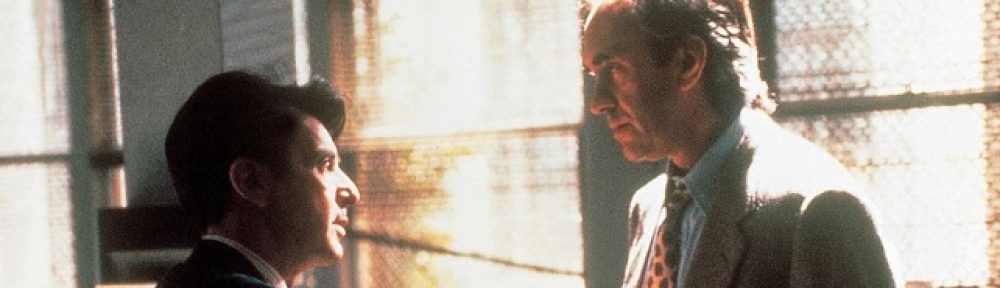
The Blue Brothers (1980 dir. John Landis)

Jake: Well, me and the Lord, we got an understanding.

Elwood: We’re on a Mission from God.

Urgent musical anarchy.

That’s the best way I know how to describe John Landis’ comedy, one that well earns its “R” rating. While there is an innocent joy of life bursting through every frame, what really makes it work is the arrogant, righteous altruism. Jake (John Belushi) and Elwood (Dan Aykroyd) really feel the spirit of God move through them as they embark on their adventure to raise $5000 for the orphanage where they grew up, still presided over by Sister Mary Stigmata (Kathleen Freeman), affectionately known as The Penguin. Either they raise the money, or the orphanage closes forever. That’s the urgency.

The blues music, coupled with the song and dance numbers, are all classics. Watch how the brothers transform an unresponsive audience into a cheering, raucous crowd with one song. In the country/western bar (“We play country AND western.”) it’s the theme from “Rawhide.” In the prison it’s “Jailhouse Rock” (of course). At the big concert it’s “Everybody Needs Somebody.” The way all of it is choreographed and edited, we believe the brothers have the magnetism and energy to rouse a skeptical audience, much as Rev. Cleophus James (James Brown) spiritually awakens not only his congregation but also Jake and Elwood early in the film. Aretha Franklin, Ray Charles, John Lee Hooker, and Cab Calloway, in a show-stopping performance of “Minnie the Moocher,” all raise this musical to another, glorious level.

There’s a scene, in the Restaurant Chez Paul (think about that name for a second) where Jake, deliberately trying to cause problems for the Maitre’d, asks another patron, “How much…for your women and children?” There’s such a sincerity to Belushi’s comedic timing with that line that one cannot help but laugh. Such is the absolute, unpredictable anarchy throughout the entire film, probably best exemplified in both the random vengeance of the mystery woman (Carrie Fisher) and the final car chase through the streets of downtown Chicago. Cars smashing into each other is not inherently funny, but with the right context, as in this film, it can be audaciously hilarious.

Movies based on Saturday Night Live characters have never been this successful or well-made (though the “Wayne’s World” movies are good). I scratch my head and feel exhausted when I consider the logistics of filming this movie, especially the final half hour of it. I can’t tell you exactly how they pulled it off, but I am grateful they did.

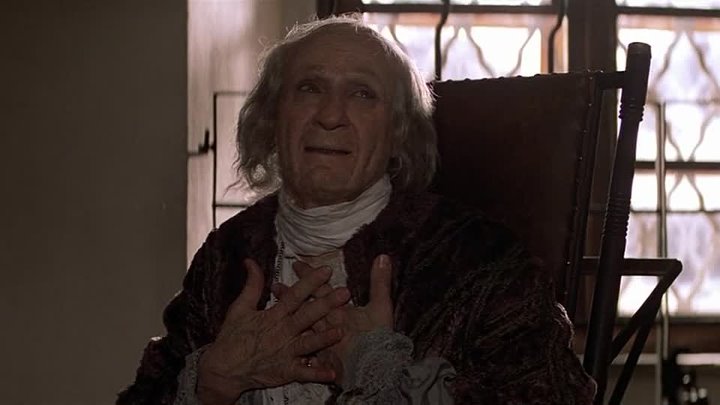
Donnie Darko (2001 dir. Richard Kelly)

Donnie and the Deus Ex Machina

Much of it is about quantum relativity’s effect on time and our inability to truly understand it…I think. A lot has been written and debated about since its premier regarding what the hell is really going on with this film. Details and dialogue have been carefully picked over as much as anything since the unseen contents of the briefcase in Pulp Fiction (1994). Richard Kelly’s movie is a cult mystery, for sure.

But interpreting the fine, specific details doesn’t trouble me at all. Just like the contents of said briefcase, not everything needs to be specifically explained in order to appreciate the overall effect. Kelly carefully utilizes thoughtful dialogue and dream-like imagery throughout the film to help us understand that what we are witnessing is not, after all, a standard story but rather an emotional journey which culminates in one young man’s simple, joyous choice to just stay in bed.

These characters are not your typical teenage coming-of-age types. In October of 1988, Donnie Darko (Jake Gyllenhaal) is an emotionally troubled high schooler who, after a near-death experience, suffers what at first seems to be deeper psychological problems but may actually be a burgeoning awareness of space-time reality. Or maybe both, I don’t know for sure, but that’s okay. His reality, or at least his sense of it, seems to both unravel and coalesce at the same time.

Most troubling are his visions of a six foot rabbit which Donnie names Frank (James Duval). The rabbit informs Donnie the end of world is coming and tells him exactly when it will happen. During the waiting Donnie meets his girlfriend, Gretchen Ross (Jena Malone); encounters a motivational speaker, Jim Cunningham (Patrick Swayze), whose own motivations may be suspect; reads a book, “The Philosophy of Time Travel” by Roberta Sparrow (Patience Cleveland) a.k.a. Grandma Death, whom he later meets.

All of this works because Kelly creates such a specific, vivid tone with the look and feel of the film. The way Donnie’s parents (Mary McDonnell & Holmes Osborne) react to him and his behavior gives the audience not only this curious and supportive tone, but also further understanding of Donnie himself. They react not in typical movie-parent ways, but as actual family to this boy whom they love and support. They worry about him, but also try to help him however they can which is exactly how I felt about Donnie watching this film.

In the end that choice I mentioned, of Donnie choosing to stay in bed, is a lot more heroic and cathartic than it sounds on paper. A lot of consequences and lives, including Frank’s and Gretchen’s, are at stake. And Frank’s true identity…well, it all just feels like it makes sense. I can’t draw a line from point A to point Z, but I know how I felt when it was all over and the soundtrack played the great “Mad World.”

I felt elated and also knowingly sad. It’s truly a unique, compelling, affecting film.

Amadeus (1984 dir. Milos Foreman)

Salieri (F. Murray Abraham), The Patron Saint of Mediocrities, holds court.

I majored in creative writing and spent countless hours in front of a keyboard, in classes, in workshops, and reading my peers’ works just as they read mine. One of my fellow students, whose name now escapes me, had the most extraordinary natural talent with words. Some of his sentences were sublime in their structure. Yet all he wrote about was, frankly, pornographic and he envisioned himself a literary pornographer, if such a thing exists. I envied how he wrote, but not what he wrote about in his stories which, I suppose, is why I never felt any jealousy towards him. I admired his talent, but never understood what he used it for those years ago.

Salieri (F. Murray Abraham), on the other hand, lives in a cesspool of jealousy, bathing in it and showering it towards not only Mozart (Tom Hulce) and his talent but also towards God and His apparent favors. The truly unforgivable part is that Salieri, at least within the film, is a contemporary of Mozart’s and will never equal the genius of Amadeus himself. Who could? And while he receives accolades and compliments from Emperor Joseph (Jeffrey Jones), deep down Salieri knows he is just not as good as Wolfgang Amadeus Mozart. He is aware of his comparable mediocrity and cannot, or actually will not, reconcile his hard work and reasonable talent with the artistic watermark embodied in Mozart.

And then there is God, an unseen but ever present character in Foreman’s perfect film. In return for musical talent and recognition, Salieri has made a vow of chastity with God. He believes his carnal sacrifice will ensure his musical genius. It does not. Mozart, as portrayed in the film, is a hard-drinking, over-sexed, immature, hedonistic genius whose innocent, pure love of music redeems his soul. Salieri loves music as well, just listen to his dialogue throughout the film as he describes notes, crescendos, and true emotional connections with the notes on his pages.

Salieri loves Mozart’s music while despising the flesh and blood man who wrote it. The film is a complex and truly moving deconstruction of the desires of the flesh versus fulfillment of the spirit. F. Murray Abraham’s layered characterization is a forever performance. Similar to Bram Stoker’s “Dracula” with Van Helsing, he plays the main character with all the exposition and dialogue but is not the titular character, which is the point. His is the real story being told, but he is not the one the audience is supposed to remember.

And all he every really wanted was to be remembered. (Now, insert Amadeus’ cackle here).

Howards End (1992 dir. James Ivory)

“Didn’t do wrong, did I?”

So asks Henry Wilcox (Anthony Hopkins) at the end of Merchant/Ivory’s magnum Opus, Howards End. His righteous insecurities already fuel enough of the conflict in James Ivory’s film, but even he cannot decide anything for himself or bring himself to look his wife in the eye when confronting his own guilt and shame regarding misbehaviors, bad choices, and broken promises.

Broken promises of unexpected gain in fact live at the heart of both E.M. Forester’s book, read only once by me, and this beautiful film. The opening scene of the film establishes the theme with the broken engagement between Helen Schlegel (Helena Bonham Carter) and Paul Wilcox (Joseph Bennett). Then Ruth Wilcox (Vanessa Redgrave) wishes to grant her home to Margaret Schlegel (Emma Thompson), only to have that promise lost by a fateful choice, at least for a time.

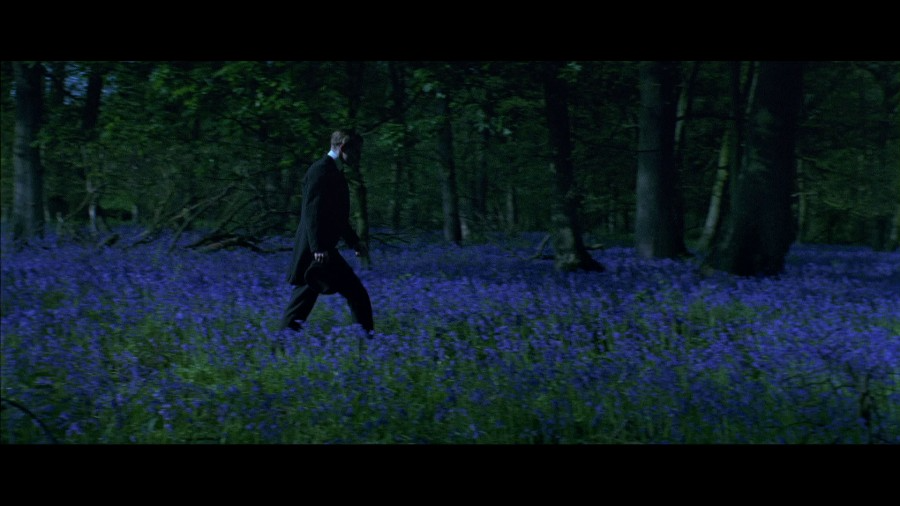
On and on the story goes, promising all sorts of social gain then altering the path so that such gain is harder and harder to reach. I suppose it’s a question of societal worth as well and what we owe to each other that matters in the end. Leonard Bast (Samuel West), who wants nothing from anyone, feels that need the most. His long trek of destiny at the end of the film, from London to the eponymous house, provides the film’s most ethereal sense of hope and dread. He will get to where he is going, but the promise of reasonable resolution will remain elusive.

Every frame of this perfect film feels lovingly blocked and realized. It drips with period detail. Watching it, I feel like I am living in Edwardian times. Much like the inside of Howards End, the film and story’s central set piece, it creates a sense of home and comfort away from the troubles of every day life. This company’s follow-up, The Remains of the Day (1993), gives that sense as well, but this film is their best overall achievement.

And when Henry asks that question at the end, “Didn’t do wrong, did I?” I remember turning to my friend in the theater in 1992 and nodding at her. Yes, yes he did do wrong. He really did.

The Matrix Resurrections (2021 dir. Lana Wachowski)

The Analyst and The One

I unexpectedly found myself reflecting a lot during and after seeing Lana Wachowski’s newest Matrix film. I kept thinking of Shakespear’s Hamlet when the Bard writes, “Doubt that the stars are fire, Doubt that the sun doth move his aides, Doubt truth to be a liar, But never doubt I love.” No matter how one interprets reality, love remains.

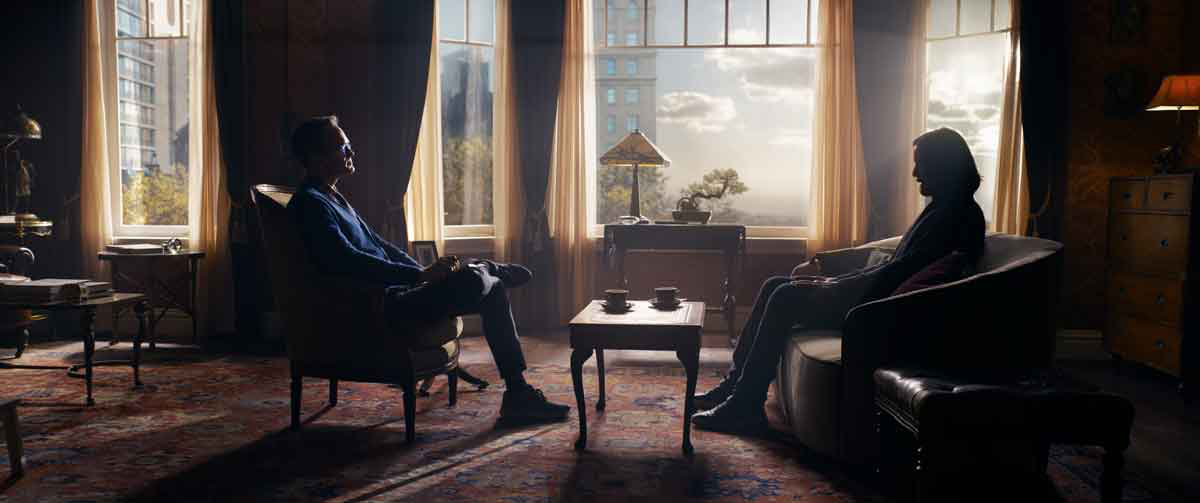
Further reflecting, there’s a scene in The Matrix (1999) that must work otherwise everything else that comes after makes no difference. It’s the scene when Morpheus (Laurence Fishburne) and Neo (Keanu Reeves) are in the white-washed construct and Morpheus gives the necessary exposition to Neo about the Matrix, what it is, what it does, and why it does. Without getting that scene right, which they do, the audience is forever lost.

I thought a lot about that scene during the first act of this new film. I had forgotten how much I enjoyed this cinematic world and how impressive it is that it all hinges on one important scene from more than two decades ago. With so much established exposition, this time they play with the mythology, seeing what they can get away with, and expanding the world even further. If you’ve never seen a Matrix film I don’t know how you’ll make sense of this one.

But more important than the world expanding premise is The Matrix Resurrections‘ simpler, more intimate story and its questions about what truly makes reality so valuable. When the confusing and unending sounds of identity, conflict, even war can be tuned out, what remains? The film argues, very well, therein remains love, no matter how you interpret reality.

Wonder Woman 1984 (2020 dir. Patty Jenkins)

Kristen Wiig, Gal Gadot, and Pedro Pascal confront greed, instant gratification and each other.

I know the feeling well. If only I had this one thing, if I could go to this one place, if I could change just this one part about myself then, well, life will be okay. The problem is that once I get that thing, go to that place, or apparently change myself then another thing, place, or trait is already waiting to tempt me, tell me I didn’t quite get it right this time but next time it will be better.

That promise of unearned privilege and reward, of instant gratification, forms the foundation of Patty Jenkins’ film. It is not the most solid of foundations but it’s constructed just well enough to uphold the chaos this story creates for its characters. I wasn’t sure about it at first, but about fifteen minutes into the film I kind of fell into accepting it for what it is.

The tone and look of it is so altered from the first film, which I rewatched the night before finally seeing this one, that I needed some time to adjust. Gone are the somber dark grays and World War I European trench warfare, replaced here with pastels and sunshine covering abundant consumerism which makes the mid-1980’s setting sort of perfect for this film’s overall thesis.

And I say thesis because it is more about ideas than story. I suppose nitpicking the plot could awaken the smart-ass critic inside of me, but the film is so good-hearted about its central focus regarding the opposition of lies and truth that I just can’t bring myself to summon my inner cynical Kraken. The film is fun, watchable, and compelling with good central performances, especially Gal Gadot once again heralding the importance of good casting, Kristen Wiig fully embodying the film’s purpose, and Pedro Pascal with his wanna-be televangical megalomaniacal insecurity.

And when the whole world begins to fulfill their wishes and the addictive disaster of instant gratification begins, I couldn’t help but just be grateful that no one wished for the world to suddenly end. I want to be here for the next Wonder Woman, after all.

12 Days of Christmas

Twelve films for Christmas, or at least ones I associate with the Holidays, listed between now and through the New Year. I had originally hoped to complete this list for Christmas Day, but a family emergency changed that plan. These are not in any particular order.

Day 7: A Christmas Story (1983 dir. Bob Clark)

It works so well because it gets the details right. The Wizard of Oz characters in the parade. Lifebuoy soap. Victor, the Lone Ranger’s nephew’s horse. Little Orphan Annie. “Frajeeelay.’ Listening to the radio that’s alway on in the background. Christmas Tree shopping and haggling. The fear of breaking one’s glasses. The anger at the school bully. The joy of receiving that one perfect Christmas gift.

You’ll notice those last three are emotional details, and that’s how the movie grabs me. It doesn’t tell me how to feel about something, it shows me people dealing with them every day. Through vignettes, universally applicable, Bob Clark’s A Christmas Story tells a story set around 1940 but true to the everyday experience of families at the holidays in the United States.

I say around 1940 because the film never really states its exact time. The clues, and you have to kind of decode them like Ralphie (Peter Billingsley) and his decoder ring, all point to circa 1939 but pre 1941, somewhere in there. I wouldn’t call it vague, but the film is brave enough to not say and that choice also keeps it universal.

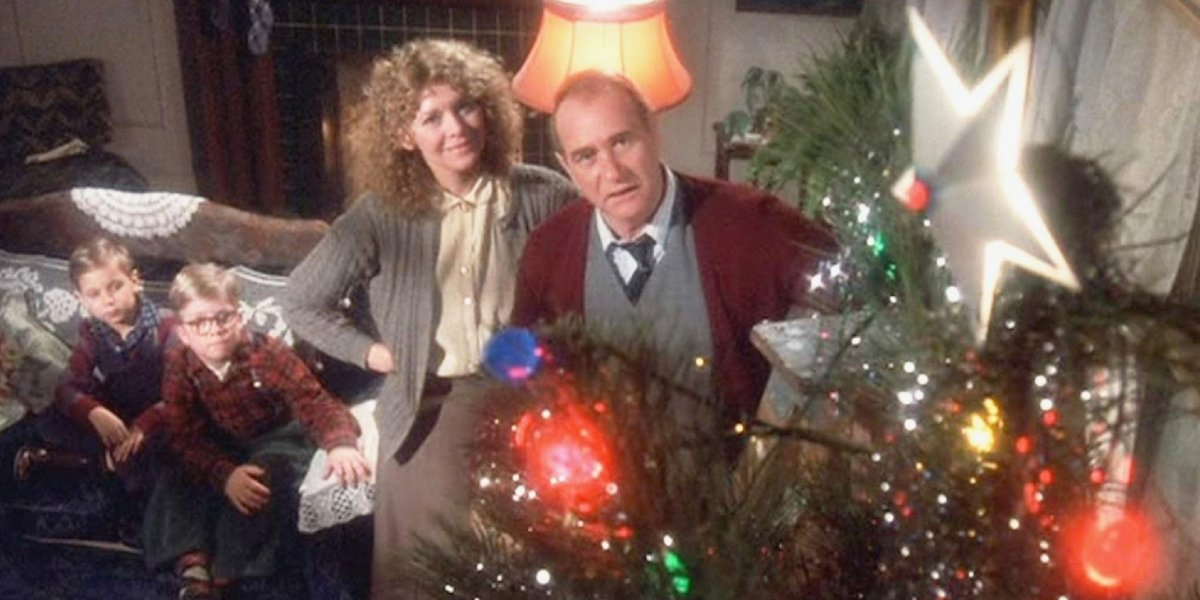
It’s a beautiful film too, containing one of my all time favorite shots in all of film history. Right at the end, Mother (Melinda Dillon) and the Old Man (Darren McGavin) are sitting facing away from the camera in the glow of the Christmas tree lights as snow gently falls outside of their front room window (no longer occupied by the major award), a chorus quietly singing a carol from the radio. It’s gorgeous stuff, detailing in an unspoken way the love and affection these two certainly must have for each other.

Of course it’s a classic, and it deserves to be one. It will always play. And I agree with Roger Ebert’s observation too, the Old Man knew about Ralphie’s fight before he got home.

12 Days of Christmas

Twelve films for Christmas, or at least ones I associate with the Holidays, listed between now and through the New Year. I had originally hoped to complete this list for Christmas Day, but a family emergency changed that plan. These are not in any particular order.

Day 6: Holiday Inn (1942 dir. Mark Sandrich)

While this film was in production, the Japanese attacked Pearl Harbor and I can sense the tonal shift right about the time the film gets to the 4th of July. There is, for the most part (and we’ll get to that), a sense of coming together, of community and camaraderie in this movie that just works. If four years later after the war It’s a Wonderful Life (1946) was a celebration of simplicity and gratitude, then this film was the herald angel prophesying that same message.

The “plot,” I use the term loosely, concerns the romantic goings on between partners Ted Hanover (Fred Astaire) and Jim Hardy (Bing Crosby) as they vie for the affection of the same woman, Linda Mason (Marjorie Reynolds). Ted is a successful night club dancer and Jim is an equally successful nightclub singer, but Jim is moving on to newer pastures, literally. He buys a farm and hopes to retire, but eventually decides to turn the farm into the eponymous Holiday Inn, a venue for performers which will only be open on holidays.

All of these story points are provided as motivation for the song & dance numbers, all composed by Irving Berlin. Most famously Berlin wrote “White Christmas” for this movie, and he won and Academy Award for it. That brilliant song fueled not only nostalgia for the wartime populace but also its own film, the beguiling but somehow entertaining technicolor populist vista-vision treat White Christmas (1954).

The standout performance for me is Fred Astaire’s 4th of July firecracker tap dance number. You can just see the joy on his face when he finally nails it. I’ve been told more than thirty takes were used to complete the dance which was a mid-production addition for patriotic war-time efforts. I also enjoy Walter Abel’s giddy nervous energy as the talent manager Danny Reed.

And then there’s “Abraham” (I mentioned we’d get around to something). *sigh* As a middle-aged white male I am not particularly qualified to give a comprehensive understanding of early film studio racist tropes except to say here definitely is one of them. This musical number, for Lincoln’s birthday, stands out amongst the rest with a jaw-droppingly inappropriate black face routine which sadly was not unheard of in its day. But there it remains, and I cannot simply ignore it, as a testament to what was and hopefully never will be again.

Still I return to this film each year. Watching Astaire work is always a joy. Hearing Crosby sing his friend Berlin’s songs is also transformative. The film gave us “White Christmas” and I can feel the fun these actors had making it.

12 Days of Christmas

Twelve films for Christmas, or at least ones I associate with the Holidays, listed between now and through the New Year. I had originally hoped to complete this list for Christmas Day, but a family emergency changed that plan. These are not in any particular order.

Day 5: Star Trek: The Motion Picture (1979 dir. Robert Wise)

I always think of Christmas when I see this film probably because I received the LP score album from my Grandmother for Christmas when I was twelve years old. It is my favorite film score even though it’s not by my favorite composer, John Williams. I hear Jerry Goldsmith’s music and I just think of Christmas.

It is not the best of the Star Trek films, but neither is it the worst; that honor lies with The Final Frontier (1989) but even that one has its well-intentioned merits. This one starts well and ends on a thoughtful, though slightly recycled, note of human discovery. The middle drags a bit as the film falls in love with its own spectacular visuals, but I still enjoy it. Premiering two and a half years after Star Wars (1977), it was Paramount’s thrown hat into the ring of big budget space adventures.

An enormous alien cloud of immense destructive power tears its way across the galaxy on a direct heading towards Earth and only the Starship Enterprise is within range to intercept it, naturally. The starship is in disrepair as it finishes refit and its new Captain, Willard Decker (Stephen Collins, enough said about him) may not have the experience needed to solve the mystery of the cloud’s origin and motives, prompting now Admiral James T. Kirk (William Shatner) to wrest command of the Enterprise and speed toward discovery.

The solving of the cloud’s mysterious beginnings helps fuel the incidental drama at work here. Is Admiral Kirk, having been away from starship command for a couple of years, even up to the task at hand? Will Spock, who does return here, find the complete lack of emotion he desires, or is there another answer? Will the Cloud’s mystery help resolve these issues and give some further enlightenment about humanity? Of course, to all of of those questions.

All of these issues are secondary to the fun had in seeing these actors working together again after ten years of syndicated reruns on television. The movie did well financially, which is not only a testament to the endurance at work here but also the launching pad for a film franchise which, with the next film (The Wrath of Khan, 1982), eventually finds its voice and rythm.

While a bit overdone, the visuals are amazing and still hold up after more than four decades. What also remains is the aforementioned score. The music is instantly recognizable and provides at least a measure of an excuse for following the middle section’s laborious journey through the cloud. And what they find at the heart of the cloud, if not entirely surprising, is worth the trip and very much Star Trek.

12 Days of Christmas

Twelve films for Christmas, or at least ones I associate with the Holidays, listed between now and through the New Year. I had originally hoped to complete this list for Christmas Day, but a family emergency changed that plan. These are not in any particular order.

Day 4: Christmas in Connecticut (1945 dir. Peter Godfrey)

I recently returned to this film for the first time in several years and I got to watch it with someone who had never seen it or even heard of it. We enjoyed it for what it is. And I keep thinking about this moment, about half-way through, when the story stops for maybe sixty seconds. It just stops, which is noticeable because the rest of the film is a flurry of zany non-stop romantic comedy hijinks. This is a very light-on-its-feet movie which crumbles under the slightest application of logic or genuine communication. You know the kind of movie I mean, where if that character would just say this one thing to that other character then the whole plot wraps up in all of ten minutes. It is the kind of story based on a big lie, a lie that must remain intact or people’s livelihoods are lost.

In this case the big lie is that Elizabeth Lane (Barbara Stanwyck) is not only a kept homemaker living on an idyllic farm in Connecticut with her husband and new baby but also someone who has time to write a very popular monthly article about delicious home cooking and the 1940’s wartime housewife lifestyle. The writing part is true, the rest is entirely fictional. Which, when you think about it, is fictional anyway because, well, it’s a movie. But I’m getting off course already. It doesn’t matter and I’m thinking too much.

What does matter, however, is the con against Alexander Yardley (Sydney Greenstreet, thank you very much), Elizabeth’s boss. If he finds out her entire persona is a fiction then she’ll be fired and won’t be able to afford the mink coat she bought for herself at the start of the movie. Still with me? Good. Because there’s also John Sloan (Reginald Gardner) who wants to marry Elizabeth and means well, but he’s a smarmy, whiny little man…who just happens to own an idyllic farm in Connecticut. What a coincidence. So when Yardley invites himself to Christmas dinner at Elizabeth’s fictional farmhouse, she can use Sloan’s farmhouse to perpetuate the lie in order to save her livelihood.

But in order to use the farmhouse Elizabeth agrees to marry Sloan the Imp. Further complicating matters is the arrival of Naval Officer Jefferson Jones (Dennis Morgan) whose knowledge of rocking chairs and their various uses borders on criminal stalking. It’s weird and creepy, but somehow endearing to Elizabeth who immediately falls in love with him and he falls for her. Of course.

There’s also the matrimony judge who has to keep escaping the farmhouse, the baby who is one day a girl and then the next day a boy (or maybe it’s the other way around), the morally empowered Irish housekeeper (Una O’Connor, thank you very much again), a cow, and the breath of fresh air that is Felix (S.Z. Sakall) who is a joy in every frame he occupies. Look…it’s all set-up and pay-off. If the set-up fails, the pay-off is a bore; if the pay-off fails the set-up was flawed. This time it all works, not flawlessly but with a little charm and a lot of dedication from the cast it comes together. If you’ve seen Mike Nichols’ The Birdcage (1996), you get the idea.

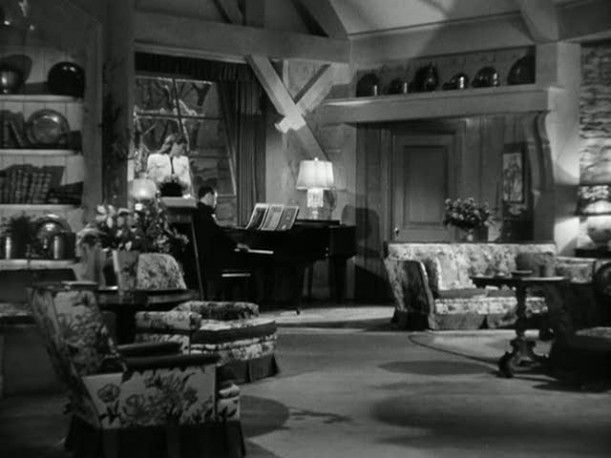
Oh and that moment when the story stops. The camera just sits in position filming Dennis Morgan playing a piano in the foreground and Barbara Stanwyck walking around in the background. It’s a quiet, contemplative, even melancholic moment and it was really nice. Thankfully it didn’t last must longer or I would’ve started thinking about the plot too much right in the middle of the movie which would’ve been, as Felix says, a “Catastroph!” Not Hunky-Dunky at all.