
I majored in creative writing and spent countless hours in front of a keyboard, in classes, in workshops, and reading my peers’ works just as they read mine. One of my fellow students, whose name now escapes me, had the most extraordinary natural talent with words. Some of his sentences were sublime in their structure. Yet all he wrote about was, frankly, pornographic and he envisioned himself a literary pornographer, if such a thing exists. I envied how he wrote, but not what he wrote about in his stories which, I suppose, is why I never felt any jealousy towards him. I admired his talent, but never understood what he used it for those years ago.
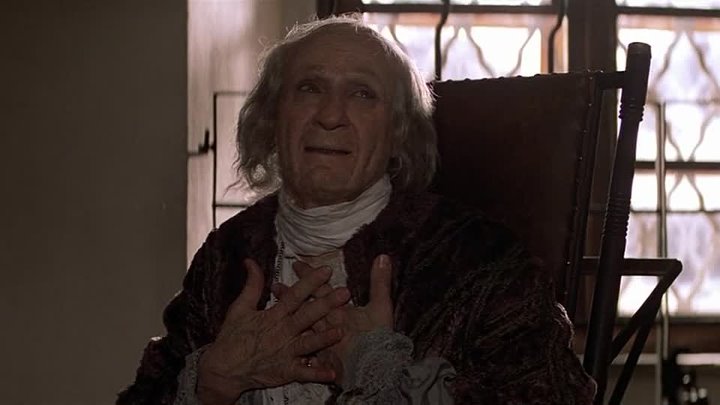
Salieri (F. Murray Abraham), on the other hand, lives in a cesspool of jealousy, bathing in it and showering it towards not only Mozart (Tom Hulce) and his talent but also towards God and His apparent favors. The truly unforgivable part is that Salieri, at least within the film, is a contemporary of Mozart’s and will never equal the genius of Amadeus himself. Who could? And while he receives accolades and compliments from Emperor Joseph (Jeffrey Jones), deep down Salieri knows he is just not as good as Wolfgang Amadeus Mozart. He is aware of his comparable mediocrity and cannot, or actually will not, reconcile his hard work and reasonable talent with the artistic watermark embodied in Mozart.
And then there is God, an unseen but ever present character in Foreman’s perfect film. In return for musical talent and recognition, Salieri has made a vow of chastity with God. He believes his carnal sacrifice will ensure his musical genius. It does not. Mozart, as portrayed in the film, is a hard-drinking, over-sexed, immature, hedonistic genius whose innocent, pure love of music redeems his soul. Salieri loves music as well, just listen to his dialogue throughout the film as he describes notes, crescendos, and true emotional connections with the notes on his pages.
Salieri loves Mozart’s music while despising the flesh and blood man who wrote it. The film is a complex and truly moving deconstruction of the desires of the flesh versus fulfillment of the spirit. F. Murray Abraham’s layered characterization is a forever performance. Similar to Bram Stoker’s “Dracula” with Van Helsing, he plays the main character with all the exposition and dialogue but is not the titular character, which is the point. His is the real story being told, but he is not the one the audience is supposed to remember.
And all he every really wanted was to be remembered. (Now, insert Amadeus’ cackle here).
 Shadows & Silence