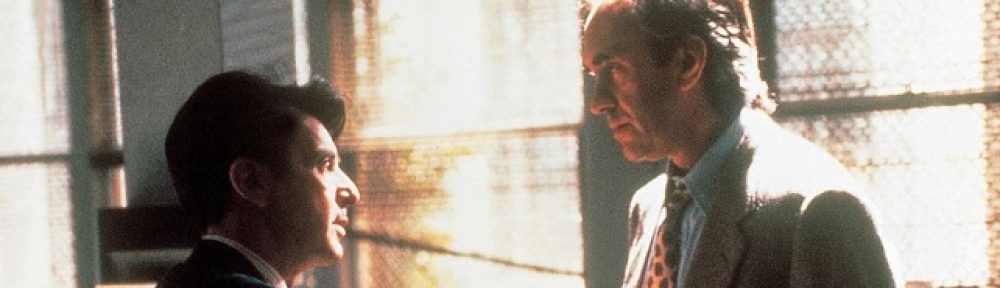

Much of it is about quantum relativity’s effect on time and our inability to truly understand it…I think. A lot has been written and debated about since its premier regarding what the hell is really going on with this film. Details and dialogue have been carefully picked over as much as anything since the unseen contents of the briefcase in Pulp Fiction (1994). Richard Kelly’s movie is a cult mystery, for sure.
But interpreting the fine, specific details doesn’t trouble me at all. Just like the contents of said briefcase, not everything needs to be specifically explained in order to appreciate the overall effect. Kelly carefully utilizes thoughtful dialogue and dream-like imagery throughout the film to help us understand that what we are witnessing is not, after all, a standard story but rather an emotional journey which culminates in one young man’s simple, joyous choice to just stay in bed.
These characters are not your typical teenage coming-of-age types. In October of 1988, Donnie Darko (Jake Gyllenhaal) is an emotionally troubled high schooler who, after a near-death experience, suffers what at first seems to be deeper psychological problems but may actually be a burgeoning awareness of space-time reality. Or maybe both, I don’t know for sure, but that’s okay. His reality, or at least his sense of it, seems to both unravel and coalesce at the same time.
Most troubling are his visions of a six foot rabbit which Donnie names Frank (James Duval). The rabbit informs Donnie the end of world is coming and tells him exactly when it will happen. During the waiting Donnie meets his girlfriend, Gretchen Ross (Jena Malone); encounters a motivational speaker, Jim Cunningham (Patrick Swayze), whose own motivations may be suspect; reads a book, “The Philosophy of Time Travel” by Roberta Sparrow (Patience Cleveland) a.k.a. Grandma Death, whom he later meets.
All of this works because Kelly creates such a specific, vivid tone with the look and feel of the film. The way Donnie’s parents (Mary McDonnell & Holmes Osborne) react to him and his behavior gives the audience not only this curious and supportive tone, but also further understanding of Donnie himself. They react not in typical movie-parent ways, but as actual family to this boy whom they love and support. They worry about him, but also try to help him however they can which is exactly how I felt about Donnie watching this film.
In the end that choice I mentioned, of Donnie choosing to stay in bed, is a lot more heroic and cathartic than it sounds on paper. A lot of consequences and lives, including Frank’s and Gretchen’s, are at stake. And Frank’s true identity…well, it all just feels like it makes sense. I can’t draw a line from point A to point Z, but I know how I felt when it was all over and the soundtrack played the great “Mad World.”
I felt elated and also knowingly sad. It’s truly a unique, compelling, affecting film.
 Shadows & Silence