Twelve films for Christmas, or at least ones I associate with the Holidays, listed between now and through the New Year. I had originally hoped to complete this list for Christmas Day, but a family emergency changed that plan. These are not in any particular order.
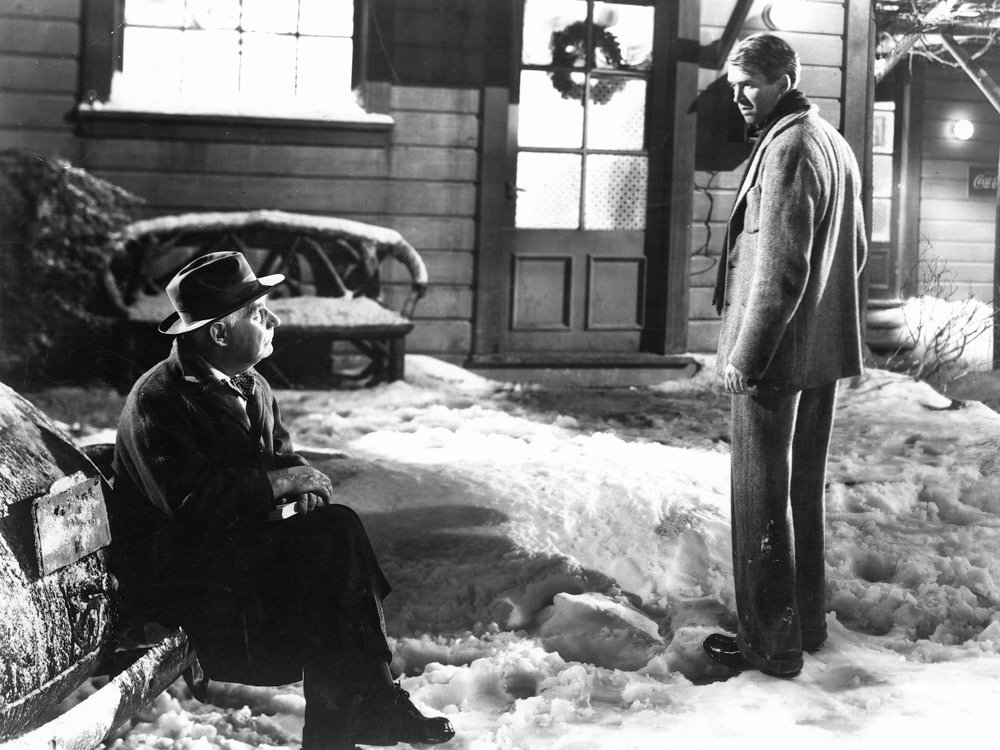
Day 3: It’s a Wonderful Life (1946 dir. Frank Capra)
How quickly life can change in a moment. Living a simple life can be so rewarding, loving, and joyful…but then it can all suddenly seem to vanish. A car accident, an illness, a miscarriage, or anything really that suddenly just happens without our consent or free will clouds one’s perspective, hopefully for just a short time. The love and support from family, friends, and community can help keep us going, one step at a time, until routine and life just seem to start again. Yet other times, despair reigns and the joy of life remains distant, perhaps even unreachable. It is within those unreachable places where miracles can happen.
What Capra and Stewart accomplish with It’s a Wonderful Life is that miracle in unreachable places. Here is a dark and terrifying film that perfectly lands upon unheard of cinematic emotional truth without any real redemption or comeuppance to its antagonist, Mr. Potter (Lionel Barrymore). He is still there, at the end, waiting to cause more problems for the Bailey family, but I suppose that is the point. Such life obstacles are always, always present. It is in how we deal with them that develops experience, maturity, and wisdom.
What a gift hindsight can be. After contemplating suicide and wishing he had never been born, George Bailey (Jimmy Stewart) get his wish when his guardian angel, Clarence (Henry Travers), changes reality so that George actually never was born. This is an ingenious concept, owing more than a little bit to Charles Dickens. But again this is not Scrooge’s story of redemption, but rather Bob Cratchitt’s story. George is a simple man with big unrequited dreams who finds happiness only after the darkest moments of his life open his soul to the possibility of meaningful joy in what he already has.
The film itself lived its own redemption story. It did not fare well with the post-war audience in 1946, and I can only surmise that the public was just not ready yet for this beautifully heavy shadow play on gratitude and simplicity. After nearly being lost forever it actually fell out of copyright at exactly the right time, allowing distributors to constantly resell it on home video cassettes and broadcast it on public television stations, all at practically no cost. It was everywhere, over and over again, until it thankfully got caught up in a kind of worldwide zeitgeist. And now, here we are at time when it is typically the top of lists, not only of the greatest holiday films ever made but also of just the greatest films ever made. And it is that good.
I have heard the film called sentimental, but I disagree. This movie earns its emotional catharsis. It does not ask more from its audience than it is willing to provide. It actually takes its time to tell a full story. And when George stands for the second time on the bridge, praying for his life, we feel his honest transparent desire. The snow begins to quietly fall again and we rejoice at both answered prayers and yes, even also at miracles in unreachable places.
 Shadows & Silence