Twenty Days & Twenty Movies

Not necessarily the best movies ever made, but these are twenty of my favorites, in no particular order.  Each post for the next twenty days will feature a brief discussion of one film (though one or two days will have multiple posts to make up for absences). 
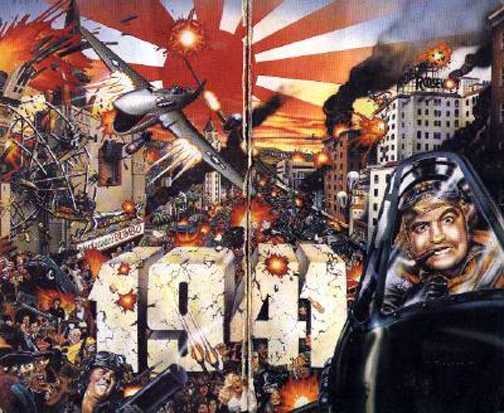
Post 1: 1941 (1979 dir. Steven Spielberg)

Maybe the most shocking thing for me about this movie was later learning it was not well-received upon its initial release.  I was alive that year, but not yet old enough to see it in theaters. Researching reviews from 1979 I can understand what critics and audiences were saying and can better appreciate their perspective.

But they were wrong.  Or perhaps the gift of hindsight has helped provide a new perspective. 

Being strictly a comedy, it is an unusual film on Spielberg’s curriculum vitae and even he has admitted Bob Zemeckis might have been a better director for the film.  It was Zemeckis and Bob Gale who wrote the script after all (they would both a few years later go on to a small project known as “Back to the Future,” perhaps you’ve heard of it).  And they wrote it from a story by John Milius.

There is an energy to this film that can only be described as musical.  It’s a freaking musical without a lot of the usual kind of music.  Instead, the action and dialogue are choregraphed to an outstanding score by John Williams.  Spielberg’s first true musical film, his take on “West Side Story,” will be in theaters later this year.

Two moments to watch for are, first, when Eddie Deezan and Murray Hamilton are on the ferris wheel and Hamilton has to admit “The dummy’s right.”  Second Slim Pickens exclaiming to Christopher Lee and Toshiro Mifune (Yes, all three of those actors in the same scene!), “I knew it.  You’re all in cahoots!”

Fear Vs. Horror

Fear and horror are not synonymous.  Fear anticipates something awful while horror experiences that awful thing.  Realizing either true fear or actual horror on screen is a rare occurrence, but one to be celebrated when done well.

Nosferatu (1922; dir. F.W. Murnau)  Fear is wondering if, as a vampire, you will be able to feed tonight.  You have to feed.  The horror is knowing you want to feed.  The blood is the life.

Frankenstein (1931; dir. James Whale)  James Whale’s image of the creature was, and still is, horrifying.  More importantly Frankenstein is not the name of the creature, but the real monster is named Frankenstein and that is truly frightening.

The Great Dictator (1940; dir. Charles Chaplin)  Chaplin’s comedic expressions in his first talkie are grounded in the fear of what might be happening in 1940 Europe.  But Chaplin must have known it was already too late, and that helplessness is horror.

Night of the Hunter (1955; dir. Charles Laughton)  What Harry Powell does to Willa Harper is horrifying; what he does to John and Pearl is frightening (“Chiiiiiildren?”).

The Bridge on the River Kwai (1957; dir. David Lean)  As a prisoner, confronting the brutal commander of your POW camp can be frightening.  Suddenly comprehending how you have helped the enemy, despite your best intentions (in what is the most fully-realized “What have I done?” moment in film history) is real, abject horror.

Halloween (1978; dir. John Carpenter)  It is horrible to find the dead bodies of your teenage friends all stuffed into different parts of the same bedroom in the house across the street.  But fear is knowing the boogie man is real, cannot be killed, and lurks in the shadows of all the houses in the neighborhood.  Well done, Mr. Carpenter.

Apocalypse Now (1979; dir. Francis Ford Coppola)  Colonel Kurtz’s madness has its method.  There is a logic to his argument about how to win the Vietnam war.  The build up to Kurtz’s entrance is fear, but making friends with horror (“the horror…the horror”) epitomizes warfare’s ultimate goal and those base emotions and behavior needed to win.

Raiders of the Lost Ark (1981; dir. Stephen Spielberg)  Snakes are fear.  Looking into the power of God and having your face melt off is horror.  Of course.

A Christmas Story (1983; dir. Bob Clark)  Waiting in a long line to talk to Santa Claus about your official Red Ryder carbine action air rifle is fear.  Getting kicked in the face and shoved down an exit slide by Santa Claus is horror.  Ho-Ho-Ho!

Babe (1995; dir. Chris Noonan)  Almost killing an innocent pig with your shotgun is horrifying.  Choosing to enter said pig into a sheep dog contest knowing you will be shamed by your peers is frightening.  But Farmer Hoggett does it anyway, and that’ll do.  That’ll do.