Not necessarily the best movies ever made, but these are twenty of my favorites, in no particular order. Each post for the next twenty days will feature a brief discussion of one film (though one or two days will have multiple posts to make up for absences).
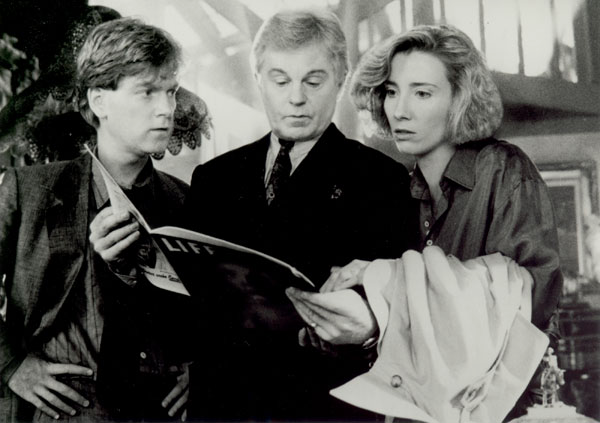
Post 9: Dead Again (1991 dir. Kenneth Branagh)
“MURDER” written in newsprint flashes across the screen, boldly opening Kenneth Branagh’s second film as director. He was coming off his brilliant success with Henry V (1989), when Scott Frank’s fun, elaborate, metaphysical script thankfully found its way into Branagh’s hands. His Shakespearean experience clearly enhances the dramatic gravitas Branagh gives to the story. There’s a lot going on here, and in another’s hands it might have come off as silly. This is not a silly film. Branagh treats it seriously. It is a bold, fearless, romantic thriller that reveals its story in broad operatic strokes.
Told not in flashbacks but in hypnotic memories, the plot concerns the murder of a woman, Margaret (Emma Thompson), in 1940’s Los Angeles then moves forward to present day (early 1990’s) weaving together the story of another woman, Grace (also Thompson), who has traumatically lost her memory. The two stories are linked and the mechanics and rules of how that link works fundamentally bring emotional weight and catharsis to its inevitable climax.
Supporting Thompson and Branagh are a host of talented actors. Andy Garcia, Robin Williams, Richard Easton, Hanna Schygulla, and Wayne Knight to name a few. It is Derek Jacobi, as Franklin Madson, who provides the personified link between the stories. His benign, innocent facade masks a paranoid, fearful motive. He preaches faith in fate, but still works to control the outcomes. “If fate works at all it works because people think that this time, it isn’t going to happen,” he tells another character right before the film’s finale, which sounds poetic, but really he’s trying to manipulate the endgame to his own satisfaction, not realizing Fate actually does have other plans.
And what a finale. Crosscutting the present-day resolution with the 1940’s and Roman (Branagh) applying the final notes to his opera just as he finds Margaret slain keeps the action, tragedy, and conclusion tumbling forward. The story is an opera itself, underscored by Patrick Doyle’s thrilling score. The opera in the film, the one about a monster, plays a part in the film’s climax, an appropriate finish to this daring story.
It is compelling and entertaining stuff. I echo what one characters states during the film, “I for one am very interested to see what happens next.” Luckily, what happens next, is worth every minute I have ever spent rewatching this movie.
 Shadows & Silence