“How do they know which way we’re going?”
Comedies challenge me. It is very difficult to amuse when people do not all laugh at the same jokes. I tend to view a comedic cast not as actors but rather as performance comedians doing their shtick. It’s an entirely unfair perception, and consequently my expectations for comedy can be very unreasonable.
To help me focus on the actor, not the comedian, I have to visualize a comedic film as a present, and my job is to open it without tearing the wrapping paper. Yes, it can feel like a chore, but a periodically rewarding one. Even so, like those “it’s the thought that counts” moments, contemporary comedies test my skills.
For a long time, Planes, Trains and Automobiles confounded me. It definitely felt like a comedy, yet it never felt like an effort. I didn’t need to think my way into this present; it just unfolded and opened itself in front of me.
Do not misunderstand. There are moments throughout the movie that still strike me as more over-the-top than necessary. Early in the film, while standing on Park Avenue, Neal Page (Steve Martin) attempts to buy a cab from another bystander, and when said cab gets away from him, he goes after it, running in the jerky, stiff movements of Steve Martin’s comedy (yes, I used the word “jerk” on purpose). It’s noticeable, and pulls me out of the suspense.
And since I mentioned noticeably awkward moments, there’s that ending…sigh…which I will address later.
Yet I forgive the film its awkward moments because for each of the very few that are there, probably twenty more organically funny moments appear. It really is a beautiful movie filled with great images, and terrific dialogue.
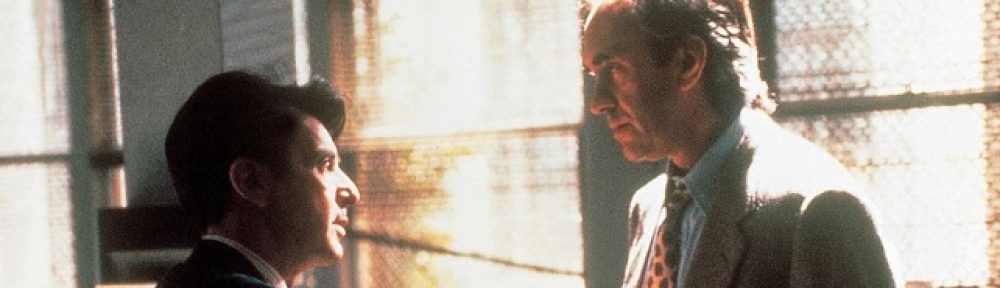
Notice that first conversation between Neal and Del Griffith (John Candy). I always refer to it as the “I Knew I Knew You” exchange and it’s the most crucial moment of dialogue in the film. Del recognizes Neal, asks Neal his name, and realizes he’s the one who stole Neal’s Park Avenue cab.
Del of course feels terrible about the situation. He offers to buy Neal some dinner as penance, a hot dog and a beer, and when Neal refuses, Del begins listing item after item of other things (“…Lifesavers, Slurpee …”). It’s the early example of how Hughes writes in Uncle Buck (1989) and Home Alone (1990).
It’s also the moment when Del imprints himself upon Neal. They establish not only their give-and-take relationship, but also their personality types. It’s like a primer for the Myers-Briggs Type Indicator assessment. Neal quietly refuses Del’s offer and remains self-reliant, but continues to inwardly scowl, preferring his judgmental superiority complex to actual human interaction. Del openly displays his emotions, figures out the problem, and then tries to solve it by appealing to Neal’s emotional needs. Hughes outlines their entire relationship, and the film’s conflict, in this simple and witty exchange.
The best dialogue comes while in St. Louis when Neal has to trudge back through snow, across bridges and runways, in order to confront his Rental Car Agent (the incomparable Edie McClurg). It’s all build-up and pay-off, leading to the film’s greatest moment, “The F-Bomb Soliloquy.” The monologue is Shakespearean, displaying Neal’s most pompous and arrogant self as he basically justifies why he’s entitled to things everyone else must be denied. I imagine David Mamet smiles at this moment.
And of course McClurg’s final response to his tantrum, her timing, and her facial expressions are perfection. It’s a one joke moment, and as good as anything from When Harry Met Sally (1989), or Some Like it Hot (1954).
Immediately before the soliloquy, as Neal walks into the car rental terminal, look carefully at his costume. His necktie is wrapped around his head to apparently cover his ears. It’s very practical, which is very Neal.
But I see something more. He doesn’t wrap it horizontally like a scarf or headband, he ties it vertically.
The image reminds me of Charles Dickens’ A Christmas Carol. The wraparound looks just as how I imagine Jacob Marley’s looks during that glorious moment in Dickens’ novella when Marley removes his handkerchief from around his skull causing his jaw to click down to his chest, opening his mouth in a horrific gape. Consider then, when Neal removes his wrap, how he too opens his mouth and speaks a horrific stream of obscenity to a stranger.
He’s neither Marley nor Scrooge, but Neal is in danger of becoming one of them; Marley, I think. I could see Neal growing regretful of his Life, lamenting how he did not try to help more people but instead focused too much on his own needs and desires. Del arrives and thus provides a pseudo-spiritual experience for Neal, helping Neal learn how to both recognize and respond to those in need.
The ending is contrived, heavy-handed sentimentalism, but I can live with it. When it comes to finding a happy ending, John Hughes never had any semblance of subtlety. Besides, I imagine Del is the one writing this story’s ending, not Neal, so the unearned emotional appeal makes complete sense.
For me, at the end, I appreciate the image of Del’s nervous hands fidgeting with his winter cap as Neal introduces family. Those little moments of dialogue and images are exactly how I have always remembered this film. Martin and Candy transcend their stand-up comedic selves and give terrific, thoughtful, funny performances. The movie really is a gift, and it’s Hughes’ best film.
 Shadows & Silence