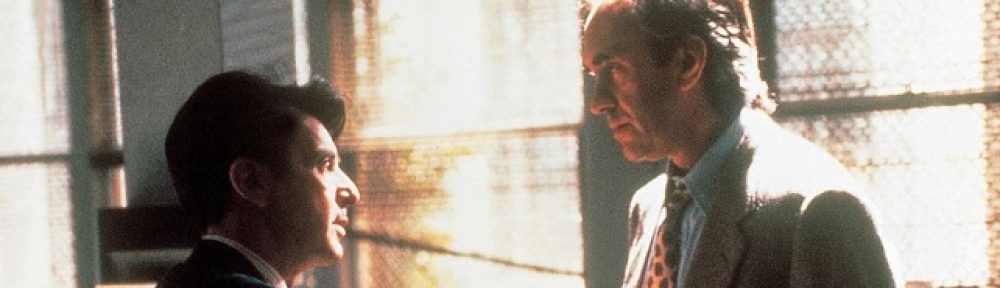
Bad Santa (2003; dir. Terry Zwigoff)

“Is Granny spry?”

Bad Santa avoids a tragic end by lowering itself into Life’s murkiest sadness.  It’s a very funny movie, but if one focuses too much on Willie Stokes’ (Billy Bob Thornton) outward behavior you might just miss the film’s poignancy.  This Santa is a decent man trapped in the life of a smarmy, self-loathing, depressive, alcoholic criminal.  After sinking so low, even the slightest upward movement feels like a triumph.

There is no formal plot to write of, but there is a story.  Willie Stokes and his partner-in-crime, Marcus (Tony Cox), annually find holiday work performing as Santa Claus and a Christmas elf, respectively.  They like to work in a mall…any mall, anywhere.  Their true purpose is to then rob that mall after closing on Christmas Eve when undeposited cash and high-end merchandise are readily available.  They change cities every year and have successfully managed this heist many times without being caught.  Their plan works.

There’s also Marcus’ wife, Lois (Lauren Tom).  She’s their getaway driver.  More importantly she scopes out the different stores looking for both security issues and for merchandise.  She keeps a list of all the things she wants, and Marcus steals each item.  He hauls it all back to her, along with the vast amount of cash money.

So, they are reasonably smart criminals.  Really, they are.  Willie, however, is in an emotionally bad way and his everyday behavior is simply out of control.  He drinks constantly, repeatedly fornicates at the mall with mall patrons, verbally scolds children and all while wearing his Santa costume.  He is not Santa Claus, and in fact clearly tells us so several times.

Willie meets a bartender (Lauren Graham) and spends a lot of time with her.  She’s very nice, very honest, and seems to genuinely like him, despite his…well, just despite him.  He also meets a Kid (Brett Kelly) and, after a near run-in with the police, worms his way into the kid’s home as a place to stay for a while.  People still like Willie even though he’s a drunk, he’s dishonest, he doesn’t like children very much, and he’s a thief.

But he’s not a bully.  No way.  Willie Stokes, if nothing else, wants you to know he is absolutely not a bully.

In fact Bad Santa is more concerned about how to handle bullies than it is a about tact, Thank God.  Terry Zwigoff’s movie knows that one cannot discuss handling bullies and still be tactful.  It destroys any audience expectation of a standard comedy when, in the very first act, Willie wets himself while in the Santa costume, sitting on Santa’s throne.  I’m always relieved he at least waited to urinate until the children were gone.

Much of the story involves Willie instructing the Kid on how to be assertive, how to stand-up for himself to bullies.  He talks to him, shares stories, yells at him and even takes the Kid to a boxing club for sparring lessons.  He knows what to do, and the Kid does learn, but Willie just never takes his own instruction to heart.  He is a defeated man, having been bullied his entire Life by his father, schoolmates, the Army, his own self-loathing and now by his partner, Marcus.

The film wisely never tells us exactly why Willie finally stands up for himself.  His self-esteem does seem moderately improved.  Clearly he’s grown fond of the Kid and after he beats up a few of the Kid’s tormentors even wonders if things feel better.  “I think I’ve turned a corner,” he admits, “I beat up some kids today, but it was for a purpose.”

Willie’s need to assert himself is clear, but the opportunity to finally express that need arrives unexpectedly.  Marcus, after years of Willie’s alcoholic misdeeds, finally decides to kill his partner.  It’s while brandishing his gun and threatening Willie that the film delivers an emotional wallop.

Faced with Marcus and death, Willie does not plead for his Life.  He even chuckles at the idea, admitting that he understands why his Life is worth ending.  In the dialogue, there is a subtle but profound shift in Willie’s tone, from scared and sad, to angry and resolved:

Marcus:  (pointing a gun at Willie) Willie, this has been a long time coming.  Every year you’re worse.  Every year less reliable.  More booze, more bullshit, more butt-fucking. 

Willie:  Sure, the three “B’s.”

Marcus:  You got to be able to rely, Willie.

Willie:  (after a moment; quietly, almost a whisper) …You people are Monsters.

Marcus:  There’s no joy in this for me.

Willie:  (indicating the gun; chuckling) I’m not talking about taking me out, that part I “get.”  But look at all that shit.  Do you really need that shit?  For Christ’s sake, it’s Christmas.

For all his faults, Willie recognizes the material excess Marcus provides to Lois, and he’s offended.  With death looming, he takes a stand against Marcus, his chief bully, by condemning Marcus not as murderer but as materialistic and shallow.  We don’t notice, but the film prepares us for this moment.

That’s masterful storytelling.

There’s so much more to write about this film and but for column space I would continue.  This film’s simple structure belies its literate achievement.  Through comedy it illustrates a very sad man, trapped in the role of a victim, who finds enough strength to finally stand up and say Maybe I’m about to die, but you’re an asshole and I’m still better than you are.

Not the usual list…

Here are ten mostly unheralded moments from film history, listed in chronological order.  Of particular importance are the individual moments, and not necessarily the films as a whole.  Oh, and these are Holiday Themed movies.

  1. ‘Twas the Night Before Christmas (1914; dir. Ashley Miller):  Simply the fact of this film’s existence.  As soon as movies could tell stories, filmmakers wanted to make this story. It’s magical.
  2. Going My Way (1944; dir. Leo McCarey):  The image of Father Fizgibbon (Barry Fitgzerald) standing stoically silent after Father O’Malley (Bing Crosby) gives him a Christmas present.
  3. It’s a Wonderful Life (1946; dir. Frank Capra):  Sure, in the end George has enough money and lots of friends, but Mr. Potter is still alive, still wealthy, and still a prick.  This is Bob Cratchit’s fairy tale, not Ebenezer Scrooge’s.
  4. Scrooge (1951; dir. Brian Desmond Hurst):  Scrooge’s (Alistair Sim) exasperated sigh of surrender when he meets the Ghost of Christmas Present, then turns away wanting to just go back to bed.
  5. A Christmas Story (1983; dir. Bob Clark):  It’s a beautifully photographed movie.  Reginald H. Morris’ cinematography gives us one of the greatest single shots in film history:  Mother and The Old Man, sitting together on an armchair, a Christmas tree alight, watching snow gently fall outside their front room window (a window, by this time, vacated by The Major Award).
  6. National Lampoon’s Christmas Vacation (1989; dir. Jeremiah S. Chechik):  Mirroring my own astonishment at how well this film was made, Clark (Chevy Chase) nicely sums up the day-to-day experience of his Life, “If I had woken up with my head sewn to the carpet, I wouldn’t be more surprised than I am right now.”
  7. The Nightmare Before Christmas (1993; dir. Henry Selick):  Frantic that he’s ruined Christmas after all, Jack asks Santa if there’s still time to set things right.  Santa simply replies, “Of course there is! I’m Santa Claus.” Kringle-Ex-Machina.
  8. Love Actually (2003; dir. Richard Curtis): Celebrating Love, happy or sad, in all of its myriad forms has rarely been so well done.
  9. Bad Santa (2003; dir. Terry Zwigoff): “You people are monsters,” he finally tells his partners-in-crime. Even the alcoholic criminal Willie Stokes has lines across which he will not step.
  10. The Polar Express (2004; dir. Robert Zemeckis): Laborious, costly and counter-intuitive, here anyway is the first feature-length motion picture crafted primarily from motion-capture technology.  And, boy howdy, it’s beautiful.

Planes, Trains and Automobiles (1987; dir. John Hughes)

“How do they know which way we’re going?”

Comedies challenge me.  It is very difficult to amuse when people do not all laugh at the same jokes.  I tend to view a comedic cast not as actors but rather as performance comedians doing their shtick.  It’s an entirely unfair perception, and consequently my expectations for comedy can be very unreasonable.

To help me focus on the actor, not the comedian, I have to visualize a comedic film as a present, and my job is to open it without tearing the wrapping paper.  Yes, it can feel like a chore, but a periodically rewarding one.  Even so, like those “it’s the thought that counts” moments, contemporary comedies test my skills.

For a long time, Planes, Trains and Automobiles confounded me.  It definitely felt like a comedy, yet it never felt like an effort.  I didn’t need to think my way into this present; it just unfolded and opened itself in front of me.

Do not misunderstand.  There are moments throughout the movie that still strike me as more over-the-top than necessary.  Early in the film, while standing on Park Avenue, Neal Page (Steve Martin) attempts to buy a cab from another bystander, and when said cab gets away from him, he goes after it, running in the jerky, stiff movements of Steve Martin’s comedy (yes, I used the word “jerk” on purpose).  It’s noticeable, and pulls me out of the suspense.

And since I mentioned noticeably awkward moments, there’s that ending…sigh…which I will address later.

Yet I forgive the film its awkward moments because for each of the very few that are there, probably twenty more organically funny moments appear.  It really is a beautiful movie filled with great images, and terrific dialogue.

Notice that first conversation between Neal and Del Griffith (John Candy).  I always refer to it as the “I Knew I Knew You” exchange and it’s the most crucial moment of dialogue in the film.  Del recognizes Neal, asks Neal his name, and realizes he’s the one who stole Neal’s Park Avenue cab.

Del of course feels terrible about the situation.  He offers to buy Neal some dinner as penance, a hot dog and a beer, and when Neal refuses, Del begins listing item after item of other things (“…Lifesavers, Slurpee …”).  It’s the early example of how Hughes writes in Uncle Buck (1989) and Home Alone (1990).

It’s also the moment when Del imprints himself upon Neal.  They establish not only their give-and-take relationship, but also their personality types.  It’s like a primer for the Myers-Briggs Type Indicator assessment.  Neal quietly refuses Del’s offer and remains self-reliant, but continues to inwardly scowl, preferring his judgmental superiority complex to actual human interaction.  Del openly displays his emotions, figures out the problem, and then tries to solve it by appealing to Neal’s emotional needs.  Hughes outlines their entire relationship, and the film’s conflict, in this simple and witty exchange.

The best dialogue comes while in St. Louis when Neal has to trudge back through snow, across bridges and runways, in order to confront his Rental Car Agent (the incomparable Edie McClurg).  It’s all build-up and pay-off, leading to the film’s greatest moment, “The F-Bomb Soliloquy.”  The monologue is Shakespearean, displaying Neal’s most pompous and arrogant self as he basically justifies why he’s entitled to things everyone else must be denied.  I imagine David Mamet smiles at this moment.

And of course McClurg’s final response to his tantrum, her timing, and her facial expressions are perfection.  It’s a one joke moment, and as good as anything from When Harry Met Sally (1989), or Some Like it Hot (1954).

Immediately before the soliloquy, as Neal walks into the car rental terminal, look carefully at his costume.  His necktie is wrapped around his head to apparently cover his ears.  It’s very practical, which is very Neal.

But I see something more.  He doesn’t wrap it horizontally like a scarf or headband, he ties it vertically.

The image reminds me of Charles Dickens’ A Christmas Carol.  The wraparound looks just as how I imagine Jacob Marley’s looks during that glorious moment in Dickens’ novella when Marley removes his handkerchief from around his skull causing his jaw to click down to his chest, opening his mouth in a horrific gape.  Consider then, when Neal removes his wrap, how he too opens his mouth and speaks a horrific stream of obscenity to a stranger.

He’s neither Marley nor Scrooge, but Neal is in danger of becoming one of them; Marley, I think.  I could see Neal growing regretful of his Life, lamenting how he did not try to help more people but instead focused too much on his own needs and desires.  Del arrives and thus provides a pseudo-spiritual experience for Neal, helping Neal learn how to both recognize and respond to those in need.

The ending is contrived, heavy-handed sentimentalism, but I can live with it.  When it comes to finding a happy ending, John Hughes never had any semblance of subtlety.  Besides, I imagine Del is the one writing this story’s ending, not Neal, so the unearned emotional appeal makes complete sense.

For me, at the end, I appreciate the image of Del’s nervous hands fidgeting with his winter cap as Neal introduces family.  Those little moments of dialogue and images are exactly how I have always remembered this film.  Martin and Candy transcend their stand-up comedic selves and give terrific, thoughtful, funny performances.  The movie really is a gift, and it’s Hughes’ best film.