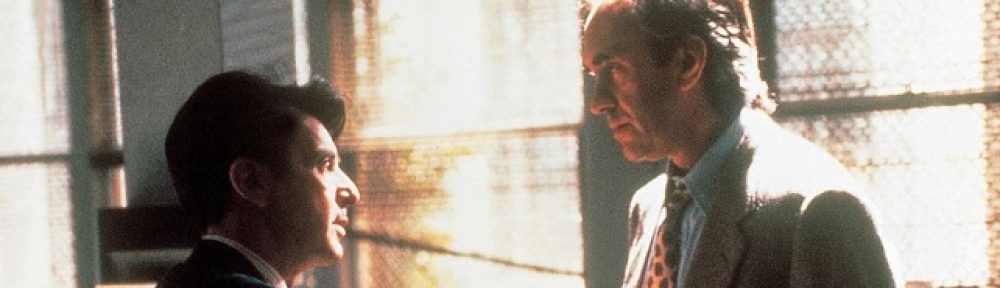
“I’m not afraid of the man who wants ten nuclear weapons, Colonel. I’m terrified of the man who only wants one.”
Here is a hauntingly prescient film.
Shortly after September 11, 2001, The Peacemaker was set to air on network television but was removed from the schedule because executives felt it too closely invoked the attacks on the United States.
They were right. It still does.
The central plot involves a large-scale terrorist threat to New York City. Since the movie handles the danger, the tone, and the pace of the story so well it can be uncomfortable viewing. My interest in this movie is irrationally profound, but has nothing to do with parallels to real life. Neither the film nor this essay belongs to any debate regarding 9/11. I point out the connection simply because it exists and I’m not going to ignore it. There it is.
Thankfully it’s not a message movie about terrorism. Instead, what has always immediately impressed me about the film is its generalized discussion of motives. Mimi Leder’s thriller is more concerned with empathy and motive than any other thriller I have seen.
The basic story is a familiar one. After stealing ten soon-to-be-decommissioned nuclear warheads from a hijacked train, a Russian General sells one of the warheads to a Serbian terrorist, Dushan Gavric (Marcel Iures), who subsequently plans to detonate the device on the island of Manhattan somewhere near the United Nations building. The U.S. government learns of the threat and sends Army Colonel Tom Devoe (George Clooney) and nuclear scientist Dr. Julia Kelly (Nicole Kidman) to confirm the plot and stop him.
It’s an action movie, and one that uses the conventions of the genre to express something new and interesting. Gunplay, car chases, red digital readouts, and megalomaniacal villains are all here. I sometimes worship at the church of Roger Ebert, and I am paraphrasing here, but I agree with his observation that movies ultimately are not what they are about, but how they are about. This film is very much concerned with how it’s about.
Watch the opening train heist sequence. It’s absurd, yes, but Leder makes it believable within the rules of the story, and that’s enough to make the film compelling. Watch also how she handles the character development during a car chase in Vienna. Clooney’s ability to become the killer soldier gives a lot of credibility to what could have been a pretty standard car chase. His seriousness prepares us for not only the way he deliberately rams one of the other vehicles over and over again, but also for his very matter-of-fact execution of one of the drivers at the end of the chase.
Films too often exercise impatience, skipping to the action without trying to explain why the action takes place. Here, even within just a quick car chase, we understand why the characters do what they do. James Bond films know how to accomplish this complexity, which is one of the most important reasons why Bond still flourishes fifty years after Dr. No (1962).
Now here’s that really interesting part about motives that I mentioned. Dushan Gavric, the Serbian terrorist, lives in Sarajevo, Bosnia where violence is a fact of everyday life. His wife and daughter are dead because of an unending war. His grief over their deaths provides the initial motive for his destructive design, but unlike other similar antagonists his motivation begins with their deaths, it doesn’t end there.
Gavric carefully and deliberately explains his motives in a video-taped confession, one that was meant to be viewed after the fact of the nuclear detonation. In it he explains why he wants the U.N. forces to evacuate his homeland. Ostensibly he is seeking revenge against the western world for what he sees as their involvement in proliferating the war that killed his family.
But Gavric does not want to kill, he wants to involve.
That his sociopathic strategy will murder thousands hardly affects him because death is not his goal, or rather not his point. Like so many villains, death is a means to an end. His calculated, horrific plan could succeed because he understands one certainty about our contemporary Human Nature: Catastrophic violence necessitates military response.
He knows that after he detonates this bomb, the U.S. will figure out what happened and respond accordingly. So while he wants the U.N. out, he’s deliberately provoking the U.S. into invading his country, a notion which at first seems contradictory. It’s not. Gavric believes that when he forces the western world to really understand the true grief of everyday war, then he will have made true peace. “Now, you must understand,” he tells the west.
Upon igniting his chain reaction of warfare, he believes overwhelming human frustration with war will reach a critical mass, finally jeopardizing the very existence of war. He is the titular peacemaker, albeit one with a very dangerous method. Violence has never been able to eradicate itself.
Listen carefully to Gavric’s final line of dialogue. I won’t quote it, but in three simple words he answers everything he needs to.
The way I contextualize all of this might seem strangely thoughtful, yet The Peacemaker merits pensive observation. The film successfully discusses what is most important to it, motive, and that’s neat. Towards the end of the film, Dr. Kelly simply asks, “Mr. Gavric, what is it you want?” (I always wonder if she is the first person to ever ask him that question). He has no rational answer because he has no realistic, tangible demands for her; all he has to ransom is what he feels.
Ransoming emotions might force immediate results, but it can never produce effective, long-term solutions. Much like terrorism.
 Shadows & Silence